
– But Only On The United States Side Of The Border
A Foreword from Niagara At Large publisher Doug Draper
When it comes to exotic species from other parts of the world that may do catastrophic damage to the life-sustaining waters of our Great Lakes for tens-of-millions of us Canadians and Americans who live around them, the Asian Carp has got to be near the top of the list.
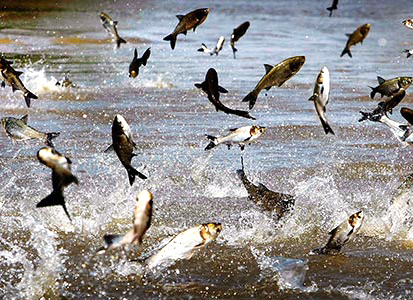
These super aggressive flying fish are just a few jumps away from entering the Great Lakes and ravaging a foodchain that sustains these fresh waterbodies for tens of millions of us living around them.
This monster fish, imported by some idiots in the lower end of the Mississippi River more than a decade go for reasons that make even less sense now than they did then, has made its way to the most upper reaches of the Mississippi River watershed, almost just a walk away from Lake Michigan in the Chicago area, and God help us if it breaches whatever barriers U.S. officials have put in place to keep them out of our Great Lakes.
You wouldn’t know it from Canadian environmental agencies – agencies whose scientists’ research we, the Canadian people pay for. Those scientists have been muzzled by the current Canadian government f Stephen Harper (or whoever runs the prime minister’s office, since Harper recently, around the Senate scandal, that he hardly has a clue what is going on in his office) from talking to the press about any threat to our Great Lakes, which just happen to be the world’s largest basins of fresh, life-sustaining water. So we have to look to the United States and its agencies to keep us informed on efforts to keep Asian carp – an invasive fish with virtually no natural North American predators, that has already proven its ability to eat up most, if not all the nutrients in our Great Lakes – a nutrient supply needed to ensure life for a multi-billion dollar fishery, not to mention other wildlife the fishery supports.
The possibility that Asian carp could populate the Great Lakes should be of concern to all of us who live in the Great Lakes basin, but you will never hear that from the Harper government, which treats any action to protect the natural environment as some sort of a communist plot or a stroke by “enemies” of economic growth”
When will a majority of Canadians finally wake up and realize that not protecting vauluable natural resources, including our Great Lakes, will ultimately destroy our economic growth?
In the meantime, let’s give bloody thanks that some agencies in the United States, pressed on by environmental groups in that country, are working to keep Asian carp out of the Great Lakes.
We are posting, immediately below a media release distributed this January 7th on this issue by the U.S.-based Alliance for the Great Lakes and by a large coalition of other American citizen groups, which should leave one wondering, where are Canadian public interest groups on this one, even if our federal government could hardly care?
NAL now leaves you with that post.
For Immediate Release: Tuesday, Jan. 7, 2014
Study: Physical Barrier Most Effective Way to Stop Invasive Species from Ravaging Great Lakes, Mississippi River
CHICAGO – The U.S. Army Corps of Engineers has identified physically separating the Mississippi River and Great Lakes watersheds as the most effective way to prevent aquatic invasive species like Asian carp from moving between the two iconic waters.
Conservation groups today responded to a congressionally mandated study released Monday that outlines eight ways to prevent the transfer of invasive organisms between the two water bodies via Chicago-area canals built more than 100 years ago to connect the two systems. Of all the options studied, the groups agreed that only one – physical separation –is effective at stopping the transfer of the various invasive fish, parasites, grasses, algae and other organisms.
“The U.S. Army Corps of Engineers study leaves no doubt that the most effective way to stop invasive species from wreaking environmental and economic harm on the Great Lakes and Mississippi River communities is through the construction of a physical barrier,” said Joel Brammeier, president and CEO of the Alliance for the Great Lakes. “This paves the way for Congress and our region to move from study to action on a permanent solution that will protect the environment, jobs and way of life for millions of people.”
The report comes soon after the Army Corps admitted in a report that a series of electrical barriers designed to repel the advancing Asian carp can be breached in a variety of ways, leaving Lake Michigan and the other Great Lakes vulnerable to the destructive non-native fish.
“All evidence points to one conclusion: Physical separation is the only defensible solution to the epidemic of invasive species which pose a threat to people, wildlife and our economy,” said Robert Hirschfeld, water policy specialist, Prairie Rivers Network. “It’s time to get away from Band-Aid approaches and toward a long-term, comprehensive, and permanent solution. This report can help us do that.”
The Army Corps findings mesh with overwhelming public support for physically separating the two systems. The public has clamored for a long-term solution to the Asian carp crisis ever since environmental DNA of the fish was discovered past the electric fence in 2009.
“More than 25,000 people, many organizations, and nearly 90 communities in the Great Lakes region concerned about an Asian carp invasion have communicated to decision makers how we want the Great Lakes separated from the Mississippi River,” states Cheryl Kallio, associate director for Freshwater Future. “We are pleased to learn the Army Corps’ report identifies how this can be done and confirms that separation is the most protective option.”
The Army Corps study pegs the cost of separating the Great Lakes and Mississippi River systems in the billions—a cost that is in-line with large-scale city infrastructure projects in cities across the region. Building a physical barrier would also mean restoring and revitalizing part of the Chicago River and the area’s drinking water and wastewater systems. It would also help address flooding.
“This is not a Chicago problem, an Illinois problem, or a regional problem. It is a national issue, that will require appropriate resources for a solution,” said Henry Henderson, NRDC Midwest director. “But the scale of the response creates a tremendous opportunity to revitalize Chicago’s failing waterways while taking essential action to protect the Great Lakes. Those don’t come often, as evidenced by the sorry state of both the river systems and the lake. This is a chance to do better.”
With the release of the study, the region’s focus now turns to putting words into action – while there’s still time to act.
“The report provides a roadmap for elected officials to move forward to protect the Great Lakes and Mississippi River communities,” said Marc Smith, senior policy manager with the National Wildlife Federation. “We look forward to working with Congress to take the next steps to implement the permanent long-term solution. The cost of inaction will be devastating to our environment, economy and quality of life.”
Ordered by Congress in 2007, the Great Lakes-Mississippi River Interbasin Study comes two years after an independent analysis by the Great Lakes Commission and Great Lakes and St. Lawrence Cities Initiative found separating the two iconic waters was both feasible and affordable.
“We are pleased the corps has concluded that restoring the historic divide between Lake Michigan and the Illinois-Mississippi River is the most effective option for halting aquatic invaders,” said Jack Darin, director of the Sierra Club, Illinois Chapter. “We know this can’t be done overnight, but now Illinois leaders can begin designing separation solutions that pay huge dividends for the Chicago region – modernized freight transportation, a much cleaner Chicago River, and new solutions to flooding problems that have plagued neighborhoods for decades. This will not only keep Asian Carp and other aquatic invaders out of Lake Michigan, but also protect the Illinois and Mississippi Rivers from other alien species that can currently enter them from the Great Lakes.”
Scientists agree that the entry of the bighead and silver carp into the Great Lakes could upend the lakes’ ecology and the region’s $7 billion fishing industry. The Chicago Waterways System, which feeds into Lake Michigan, has been identified as the most likely route for the carp to enter the Great Lakes.
“Federal investments to restore and protect the Great Lakes are producing results, but those investments are at risk,” said Todd Ambs, campaign director for the Healing Our Waters-Great Lakes Coalition. “Allowing the Asian carp to enter the Great Lakes will undermine restoration efforts. This report confirms that we have an effective solution to protect the Great Lakes from these invaders. It’s now time to act. Delay will only make the problem more complicated and expensive to solve.”
The citizen groups sending you this media release include Alliance for the Great Lakes – Clean Water Action-Minnesota – Freshwater Future – Healing Our Waters-Great Lakes Coalition – Milwaukee Riverkeeper – National Wildlife Federation – Ohio Environmental Council – Natural Resources Defense Council – Prairie Rivers Network – Sierra Club
For more information on Asian carp and the possible threat of this invasive fish t the Great Lakes check out the U.S. Fish And Wildlife Service’s information by clicking on http://www.fws.gov/midwest/fisheries/asian-carp.html .
(Niagara At Large invites you to share your views on this post. A reminder that we only post comments by individuals who share their first and last name with them.)
 Niagara At Large
Lets hope the US does something about this – NOW!
It was their “idiots” who introduced the damn things in the first place. They should be the ones paying for the project to stop the spread.
They also should be working to find a way to kill off the invaders.
LikeLike
Zebra mussels…. now this…… these are the things we KNOW of…. what don’t we know of….
Our government should be all over this…. If it truly isn’t we deserve answers… We deserve accountability….
Now I know Doug has a beef with Harper et al…. but where o where are the opposition parties whose sole purpose is to hold the governing party to task on these types of subject matter? Our government, ALL OF IT, is whacked!
Just sayin…..
LikeLike