
– We Need A Conservation Plan That Serves The Long-Term Interests Of ALL Niagara Residents
By John Bacher
One evening this past December, 2013 at the Nature Interpretation Center of the Niagara Peninsula Conservation Authority, there was another of the epic battles which have been held for the past two years under the guise of a ‘Strategic Plan’ review.
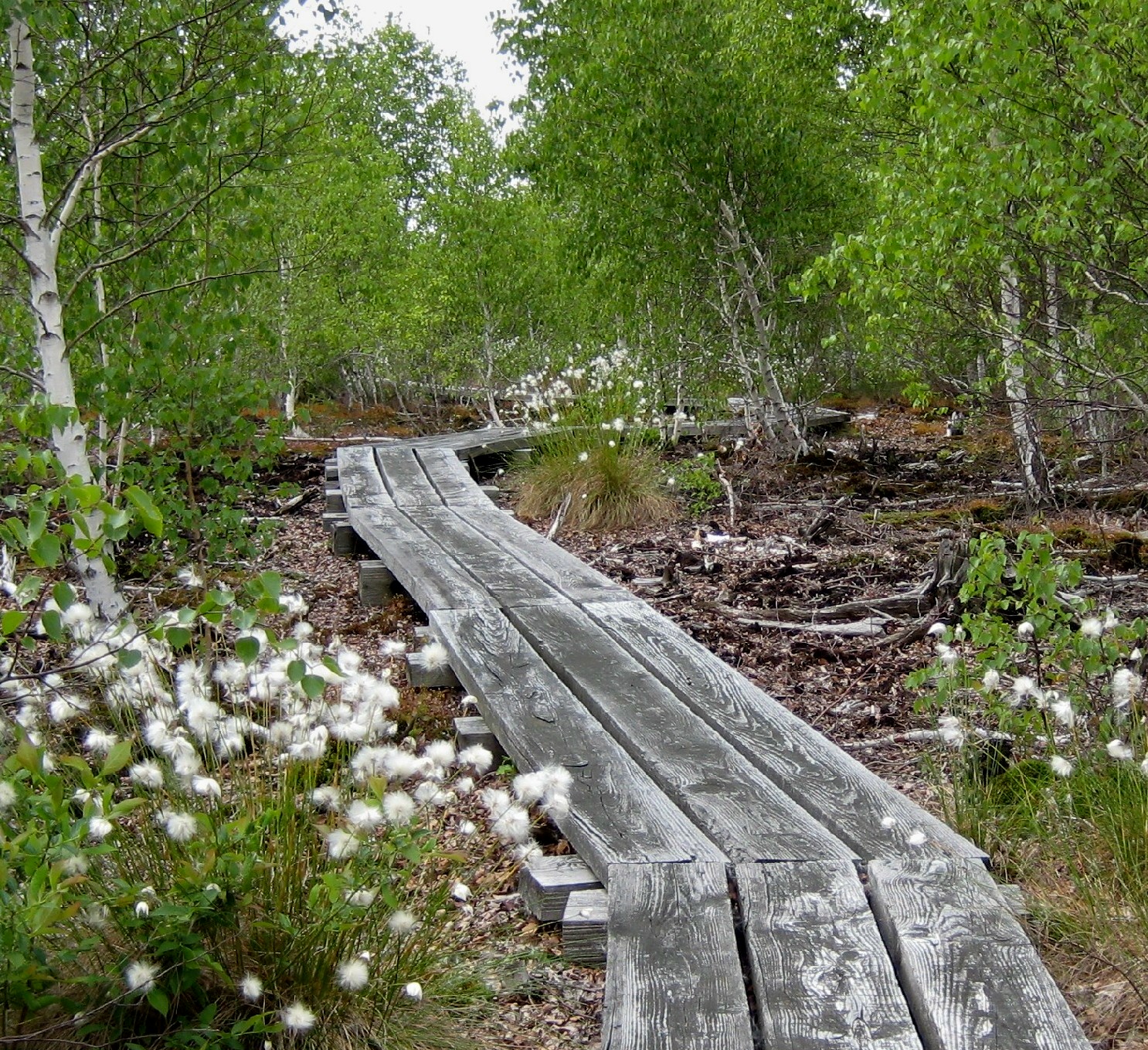
A trail through the Wainfleet Bog, one of the great conservation areas in Niagara, Ontario under the jurisdiction of the Niagara Peninsula Conservation Authority. .File photo from NPCA.
Usually the monthly board meetings of the Niagara Peninsula Conservation Authority or NPCA, for short, held in offices in Welland on Thorold Road next to Centennial High School, receive little public attention. Yet about 30 concerned conservationists came out to this one, the anticipation of which caused the relocation of the meeting to the NPCA’s Ball’s Falls site.
While most of the skirmishes over the NPCA’s Strategic Plan – have been held behind closed doors (with the minions of developers harassing NPCA staff and the minutes of those meetings never published), this stage of the drama was held in public although, predictably, no press was present.What was of interest that emerged in the December NPCA board meeting was a refreshingly candid report by Bruce Timms, a St. Catharines regional councillor who, last year, replaced Niagara Falls regional councillor Bart Maves as the board’s Chair. He reported that most of the opposition to the Strategic Plan focused on one line of its text that spoke of the possible “disposal” of NPCA properties.
Timms’ helpful summary comments were reinforced by those of another NPCA director, Doug Ransom, a representative from West Lincoln. He indicated that most of the comments received to date on the Strategic Plan expressed opposition to the sale of any NPCA properties.
What was revealing of the internal wrangling between the municipal politicians in the NPCA watershed area was a summary of discussions about what current policies for land acquisition were. It was reported that in the City of Hamilton, part of which falls within the NPCA’s area of jurisdiction, there were plans to spend $100,000 to acquire land. In the Niagara Region, there was a figure of $500,000 proposed, but that figure was the subject of extensive political debate. (The lower figure for Hamilton is reasonable, since the area of the NPCA boundaries in the Niagara Region is much greater).
The NPCA”s debate about a land acquisition are complex. Some politicians are opposed he to creating a reserve for land purchases. Others felt that all the money in such a reserve should be used to acquire lakefront property. A number of councillors have urged that lands from the former Easter Seals Camp on Lake Erie in Wainfleet, which are surplus to a developer’s needs, be acquired.
The debate over land acquisitions shows the mess of the draft Strategic Plan which, if approved, will simply become a tool for developer’s mischief. Part of the mandate of the NPCA under the Conservation Authorities Act, is to acquire lands for public recreation. It is legitimate that lakefront properties for this purpose, such as beaches for swimming, be acquired.
What is ironic here, considering the current internal debate among regional councillors in Niagara, is that if a dedicated fund to acquire land had existed a decade ago, all of Easter Seals property along the shores of Lake Erie could have been purchased. Instead what is now being proposed is the purchase of lands the developer of a residential development could not build upon being subject to a variety of environmental constraints.
Considering that many of the politicians that serve on the NPCA board are interested in acquiring lakefront property for recreational purposes, it is astonishing that the draft Strategic Plan has nothing to say about this. This points to the odious nature of the current draft document.
Politicians and NPCA directors have little to do with the actual content of the draft Strategic Plan. That content is the product of the anti-conservationists who were invited within the past few years to sit on the secret committees.
No minutes have been released of the deliberations of these closed committees. None of the voluminous studies used during this process have been made public. The names of the persons serving on the committees have not been made public. Much of the internal debate was over the protection of Pin Oak swamp wetlands from development in Niagara Falls.
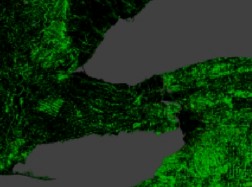
The green areas in this image show the forest cover in Niagara and surrounding areas, including Western New York. Click on this image to blow it up to full screen.
This draft Strategic Plan does not discuss the problem with Niagara having only 18 per cent forest cover, which encourages flooding, stream desiccation and phosphorous over loadings. Most of the people on the committees that drafted this draft plan want to further cut down the forest cover in Niagara.
In summary, the attitude of those driving the NPCA’s Strategic Plan is a serious problem. Outside of Norfolk County and native reservations, Niagara has the best forest cover in Carolinian Canada. (Note photo with story) The lovers of the draft Strategic Plan formulated by the agents of developers on secret committees, would love to cut it down.
The Strategic Plan needs to discuss how we can have more forest cover in Niagara, not a possible reduction of forest cover through the selling off NPCA’s conservation lands, and not through the reduction of reducing NPCA staff to please those developers who are not willing t work with the Conservation Authority to conserve what is left of our forests and related natural lands.
What we need is an entirely new process to development a Strategic Plan that is in the best interest of all residents in the Niagara watershed and what is left of this region’s natural heritage.
John Bacher is a Niagara resident and veteran citizen advocate for protecting and preserving this region’s green spaces.
(Niagara At Large invites you to share your views on this post. A reminder that we only post comments by individuals who share their first and last name with them.)
 Niagara At Large
Who are the Conservationists?
Well the common belief is that they are the folks that oversee the health and welfare of our beautiful natural environment. We are lead to believe that they protect us from the hazards of pollution.
They would have us believe that under the incompetent Ontario Ministry of the Environment they are the conservators of clean fresh water, pristine woodlands and immaculate meadows.
If we are stupid enough to believe they are, what they say they are, then we could be accused of being more than a little bit gullible.
Ask yourself, or better yet, ask them just what they have done to fulfill their mandate that they are getting paid for? Ask if our outdated sewage lagoons are still pouring semi-raw sewage into our fresh water sources, polluting our beaches and fouling our water intakes.
Ask them why they’re trying to financially destroy a family with fines accumulating into the $Millions.
And just what were the outrageous and egregious transgressions perpetrated against mother nature to warrant the attempt to ruin this family and deprive them of their very property?
Where the fines really imposed predicated on his efforts to carefully husband his land at the top of the Niagara Escarpment?
These conservationists were concerned that an archery school was being conducted in the very impressive woods this family created!
Juxtapose the conduct of these so-called conservationists with their refusal to even hear from a family that suffered from a business that graded the top of the Niagara escarpment to such an extent that it causes their home below to continually flood with mud.
But why should we be surprised by anything from a group that would give permission to the folks of a former ‘roadhouse’ to operate a B&B as long as they didn’t hire help?
A group that tells a family that they can’t sell their produce at the roadside.
A group that refuses to act on toxic pollution information unless the pollution is the responsibility of anyone other than that of government, their friends and especially their ‘partners’.
A group that builds a commercial banquet hall in a conservation area. Many speculate the banquet hall is just a ruse to quietly create an ‘unwanted’ headquarters in that same pristine conservation area.
http://newsalertniagara.blogspot.ca/2013/12/conservationists.html
LikeLike
Thank you John, for bringing this into the open. I understand that organizations are considering asking the province to step in. I too would like to see the process begin again, to ensure that the provincial mandate is adhered to, that appropriate ‘public participation’ is included, that meetings/decisions are open to scrutiny, and that board members are grounded in best CA practices.
LikeLike
I hope that my initial enthusiasm of this report is not to be dashed by Developers . I thought it was the beginning of Governments finaly revering our watersheds . Thus enhancing their natural filtration ability through vegetative buffers between the watersheds and land use operations . NOT mapping out areas that are not suitable for developers thus the remaining land therefore is protected from development . How insane is that !! Thanks again Doug for giving us eyes on what is happening in Niagara !
LikeLike
I normally would not comment on something about which I know far less than many others. I’ve thoroughly read the comments, and note, as in writing this, that the Bay Beach condo development is now defunct. Great news, I hope this one goes south as well. Just a comment: Jim Bradley was not the Minister of the Environment during the Walkerton crisisas one writer has suggested; the Harris government was in power, and the liberals in opposition. Indeed, the late Frank Sheehan was the Conservative MPP who led the Red Tape Committee which cut out transparency and reporting back to the Harris Government. Just sayin’
LikeLike
Dear Ms. Benjafield,
I didn’t see where anyone suggested that Jim Bradley was the Minister of the Environment during the Walkerton crisis.
However you should be aware that Jim Bradley was the Minister of the Environment when the permit was granted to create the Walkerton well downhill from the manure yard.
Then his ministry had the audacity to blame the private water testing sight of tardiness. That private tester responds in 24 hours and phones immediately when contaminants are detected. Our government testers take five (5) days to respond.
According to Environment Canada the veracity of everything thing under the control of the Ontario Ministry of the Environment has become suspect.
The Walkerton tragedy was predicated on dereliction of duty by a drunk not the late and great MPP Frank Sheehan, who did his best to cut red tape. And just what transparency are you talking about? There isn’t any! Just Sayin’
LikeLike
Very good analysis, Doug and some more thought provoking comments will undoubtedly follow. One long question that I have is: ‘What is the nature and makeup of the pro-environmental movement in the Niagara Region and are they sufficiently active and coalesced to make an impact on NPCA as it changes its organizational focus and priorities?’
I was not aware of the forest-cover statistics that you cited – very interesting. I know that southern Ontario has lost a huge percentage of its wetlands in the last decade. Ducks Unlimited of Canada has been active, politically and in the field, in the advocacy of wetland remediation and conservation.
Looking at the new top management team biographies at the NPCA website, the three big late-December appointments had educational credentials of business administration, law and political science – with matching professional experience. This could be good, as NPCA confronts the increasing complexity of the enterprise. Still, I would be more comforted in someone with ‘environmental science’ running through the resume as part of management leaders.
A last point. To me, the NPCA governance model seems outdated and reform should be, at least, considered. I would call for a more pluralistic model than the current control of regional/municipal political jurisdictions provides. Looking at other watershed agencies around the world for models could be a start to this. Then, contextualizing a governance review with the three key concept of the Conservation Authorities Act – local initiative, watershed jurisdiction and cost sharing – could be a framework for reform.
LikeLike
The Late MPP Peter Kormos brought a bill forward in Queen’s Park attempted to harness the flood of political appointments that seems to grow into “Special Interest” empires, empires with little concern for or about the very reason they are initially put in place. One only has to look at the sunshine list or read articles like the many that appear in this medium, (including this eye opening article above) pointing out just how thoroughly special interest agendas have taken over or in reality have bought out theses committees and literally own them.
They don’t care about anything but their own “for Profit and their egos” as these empires are being built and most taxpayer are kept in the dark through the use of back room appointed sub committees and “in Camera” sessions that seems to preclude honesty and open dialogue.
This bill was defeated by proponents of Special interests and the rewards they garner from keeping the status quo alive and growing..
I hope I am right when I thank and back people like John Bacher
LikeLike
Dear Ms. Benjafield,
I didn’t see where anyone suggested that Jim Bradley was the Minister of the Environment during the Walkerton crisis.
However you should be aware that Jim Bradley was the Minister of the Environment when the permit was granted to create the Walkerton well downhill from the manure yard. Then his ministry had the audacity to blame the private water testing sight of tardiness. That private tester responds in 24 hours and phones immediately when contaminants are detected. Our government testers take five (5) days to respond.
According to Environment Canada the veracity of everything thing under the control of the Ontario Ministry of the Environment has become suspect.
The Walkerton tragedy was predicated on dereliction of duty by a drunk not the late and great MPP Frank Sheehan, who did his best to cut red tape. And just what transparency are you talking about? There isn’t any! Just Sayin’
LikeLike
If there was ever an area that needed Provincial protection and enhancement of it’s watersheds , it is the Niagara Region . We are placed strategically between two Great Lakes . Thus the Land use planning has an enormous affect on the Health of these bodies of water . We spend Billions cleaning and processing the Lake water so it can be fit for human use . Why not use our Natural Filtration Systems ( streams ,creeks and rivers ) to do alot of this before this water empties into the Great Lakes . Not only is it good for everyones Health . It is also so much more economical . Once the watersheds have been restored and protected from land use operations ( Silt Lodes , Chemicals and Fertilizers ) . Once Buffered they remain basically intact thus no overhead on maintenance as we do now with man made ditching ! To rebuffer our watersheds could provide much needed employment in the short run for people willing to feed their families with a hard days work . But once established we would have their powers to clense our Great Lakes forever . Not to mention providing corridors for the movement of Flora and Fauna .
LikeLike
In Stevensville back in 1980 a sewage system was set up to stop raw sewage, via overflowing septic tanks, pouring into Black Creek and causing a health danger, so a sewage pond (lagoon) was put in, over the municipal line in Niagara Falls, designed for under 2 thousand people now has 3 thousand people, and during the summer thousands of concert fans also come to Town, the sewage overflow pours directly into the Niagara River, where it flows toward the Chippawa water intakes, same thing happened up north to the native peoples, who had to be evacuated ASAP,.does anybody not see a consequence to these dangerous methods.??
LikeLike