
By Nick Fillmore
(A Brief Note from Niagara At Large publisher Doug Draper – Once again, NAL is proud to run a post from a long-time, true crusader for investigative journalism in Canada, Nick Fillmore. You can check out his great blog site at nickfillmore.blogspot.com , but please don’t go there until you read his article on this important subject here and join the discussion at the very bottom with comments of your own on the issue for our growing community of NAL readers.)
Introduction: The world banking system could come crashing down around our heads again – even worse than in 2008. Many of the giant banks are carrying on the same overly risky and even illegal activities that led to the earlier crisis. In this article, investigative journalist Nick Fillmore writes about the health of the Canadian financial sector.
By Nick Fillmore
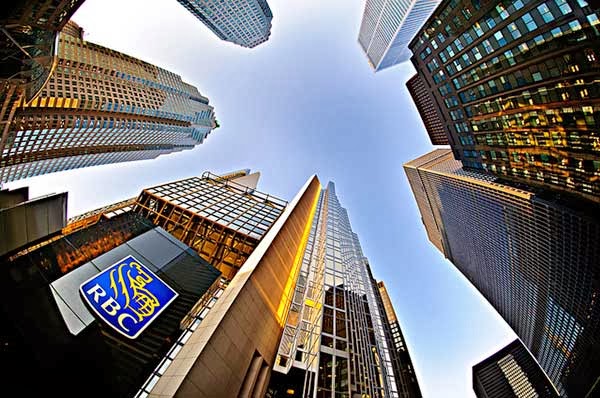
Could the Canadian bank towers looming over us come tumbling down on us?
The public is almost entirely unaware that our banking system, with just a couple of wrong moves or some bad luck, could go into a tailspin at any time. And when the next serious setback occurs, we could end up suffering even more than in 2008-2010. There is no need for panic, but government regulators allow our entire financial system to operate dangerously on the edge. When the system crashes again, it will be ordinary people and people at the bottom of the economic ladder who will suffer the most. The Great Recession cost every Canadian an average of $12,000. Employment fell by 362,500 jobs between October 2008 and May 2009, and many of the new jobs are low paying.
Throughout the Great Recession, Finance Minister Jim Flaherty and the financial community managed to keep secret the fact that our largest banks were in financial difficulty. Had people known the reality, they might have wanted their money back.
In fact, all of Canada’s five big banks (BMO, CIBC, Toronto-Dominion, Scotiabank, and the Royal Bank of Canada) faced serious financial problems in 2008, the Canadian Centre for Policy Alternatives (CCPA) has found. Most held far too many toxic U.S. subprime mortgages, the same mortgages that sank the U.S. economy.
All totalled, the five wrote down losses of $16.17- billion during the financial crisis. What ensured the banks survival was massive relief, worth $114 billion, from three sources: the Central Mortgage and Housing Corporation, the U.S. Federal Reserve, and the Bank of Canada.
Canadian executives still got the big bucks
Interestingly, as the big five banks were receiving billions of dollars in taxpayer support, some of their executives were the highest paid in North America. Gordon Nixon of the Royal Bank, and Ed Clark of the Toronto Dominion, received about $C10.4 million each. That topped even the $US9.6 million salary and bonus awarded to Goldman Sachs Group CEO and Chairman Lloyd Blankfein.
The governing Conservatives had their own reason for wanting to keep the banking crisis secret: 2008 was also a federal election year. Unaware of the crisis, Canadians re-elected a minority Conservative government. Had voters known the extent of the financial crisis, there might have been a different outcome.
Canadian banks remain extremely vulnerable for several reasons. For one, they are making loans and investments valued into the billions of dollars, without holding enough in reserve funds should disaster strike.
Secondly, many of our banks’ activities are inter-twined with the same U.S. and European financial institutions that are still gambling and taking risks as they did during the period leading up to the collapse.
Not (nearly) as strong as they look
“Despite what is commonly understood,” writes Chris Ferreira,
who runs the website Economic Reason, “the Canadian banking system is not as strong and resilient as most people might assume. If Canadian banks are so strong, why did they need to be rescued in 2008?”
Our financial system is fragile enough that it could equally suffer a shock from within: A collapse of housing values, the implosion of Europe’s financial system reaching into Canada, stress on the economy because of high personal debt, not enough reserve cash in banks to cover their debts in the event of a declining economy.
Globally, while many of the big banks that survived are in better shape than they were in 2008, many refuse to adhere to new government regulations. They take more risks than ever, and some even engage in dangerous illegal activities.
Unfortunately, most people tend to throw their hands up in frustration when the topic of banks and bank profits comes up. The general public has no idea what the banks are up to.
Why did the Big Five come so close to the brink?
Looking back, people might wonder how Canada’s top five banks, with assets running into trillions of dollars, could nearly collapse with losses of only $16.17 billion.
It’s simple. The banks failed to have enough hard-cash reserve assets on hand to cover their losses when things started going South.
This points to a fundamental flaw – and a danger for the public – in the banking system. Most people believe that banks loan out no more than the amount of money they have in their vault. Not so.
Canadian banks, and banks in most countries, keep only a fraction of the money on hand that they loan out or invest.
Based on calmer times of a few years ago, the banks assume they will not have any major setbacks. But the Canadian banks were not as “safe” going into the recession as we were led to believe.
“Canadian banks were actually significantly more leveraged – and therefore more risky – than well-run American commercial banks,” wrote Peter Boone and Simon Johnson, two widely-read U.S. analysts.
“For example JP Morgan was 13 times leveraged at the end of 2008, and Wells Fargo was 11 times leveraged. Canada’s five largest banks averaged 19 times leveraged, with the largest bank, Royal Bank of Canada, 23 times leveraged.”
In the U.S., banks are required to have cash assets valued at 10 per cent of their total investments/loans on hand – in case they have to cope with unforeseen losses.
Meanwhile, Canadian banks are required to hold only seven percent of their outstanding debt in backup cash or cash equivalents. Even so, most of Canada’s big banks have reserves of at least 10 per cent.
A minimum 20 per cent rule
The back-up cash-equivalent equity kept on hand should be about 20 or 30 per cent of a bank’s financial obligations, Neil Barofsky said in an interview with Bloomberg TV. Barofsky should know. He was the Special United States Treasury Department Inspector General overseeing the Troubled Assets Relief Program (TARP), America’s principle bail-out instrument, from late 2008 until March 2011.
Bank executives nonetheless oppose the idea of having high reserves. They say it would restrict them from making their full potential profit on the funds held in reserve.
Cyprus shocks the financial world
Shockwaves went around the world in March, 2013, when the main bank in Cyprus not only refused to give people back their money, but actually began seizing money from the accounts of people with fairly large savings to pay its own debts.
Given the uncertain future of the world financial sector, it’s unclear whether Canadians will be able to get some kinds of money back in the event of a severe financial collapse. We should never say, “It can’t happen here.”
Large Canadian businesses likely will have non-governmental insurance of $1-million to protect their bank holdings.
In the event of a major crash, Canadians with smallish savings accounts and pension plans, etc., might be protected for up to $100,000. Finance Minister Jim Flaherty says he won’t touch people’s personal savings but, who can say what might happen in a crisis.
If the economy really hits the wall, there could be a run on assets as people try to reclaim their money. There likely would not be enough money to go round. This is because, counting everything in the world, we all are deep in debt. Perhaps whoever grabs the money flying around first gets to keep it.
The message for the public is that we should not trust the bankers in the 21st Century. The men who control the big, powerful banks today are not the same guys who used to give us small business loans or look after our mortgages many years ago.
Nick Fillmore is a Toronto blogger and sometimes investigative journalist. He worked in several capacities at the CBC over 25 years, and was a founder of the Canadian Association of Journalists. Email comments welcome: fillmore0274@rogers.com and please visit Nick’s blog at nickfillmore.blogspot.com
Nick wishes to thank The Tyee for its support, which permitted him to research and write this article.
(Niagara At Large invites you to share your views on this post. A reminder that we only post comments by individuals who share their first and last name with them.)
 Niagara At Large
Thank-you , please let me know if you are hiring a proof reader , would be happy to do the job . Take care Betty Audy
LikeLike
This is very disturbing. Are the Credit Unions any safer?
LikeLike
It’s nice to see one person understands the folly of fractional reserve banking. Too bad so few do.
How about a public expose on the stupidity of Keynesianism, which is what causes these boom-bust messes in the first place?
Start with the Austrian School of economics. Austrians — economists, not citizens — predicted the 08 mess in 01 when Greenspan goosed the economy with low interest rates.
LikeLike