
By Mark Taliano
Resource-rich Honduras, once considered the “bread basket of Central America”, is now a failed state.
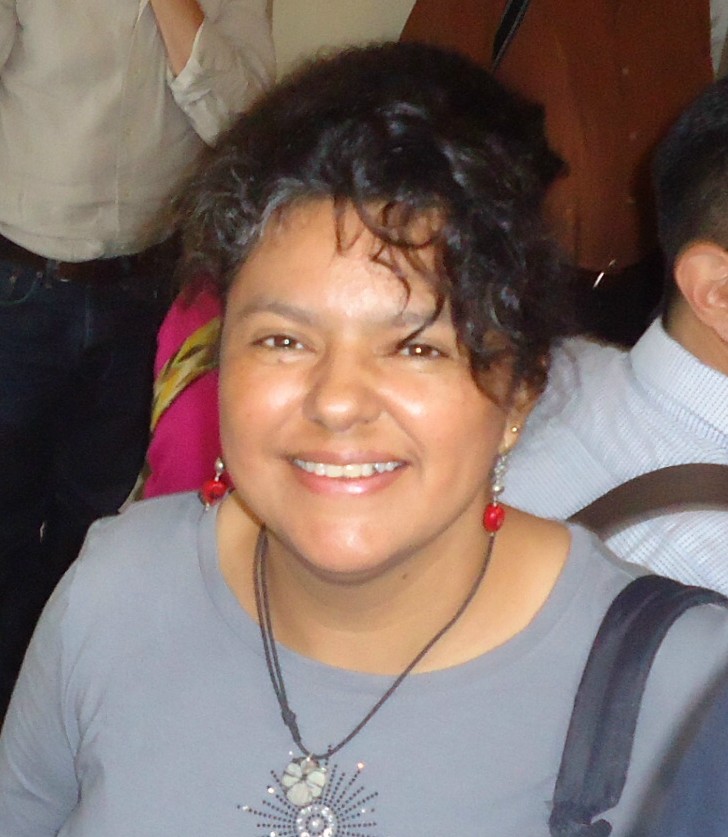
Bertha Isabel Caceres Flores Ienca, an indigenous leader in Hornduras is on the presiding govenment’s number one ‘kill list’. Photo courtesy of Mark Taliano.
More than half of the population lives in poverty, and the country boasts the world’s highest murder rate. The title “Murder Capital of the World” is well earned, especially since impunity for murder is the rule rather than the exception.
In 1989, local farmers supplied 90 per cent of its food requirements, with 20,000 farmers making their living through the production of rice. Now, there are 1,300 rice farmers, and the best land is inaccessible.
Thanks to the World Bank and IMF loans —- bundled with destructive neoliberal economic policies — the best farmland now supports lucrative monoculture plantations of African Palm, harvested to serve global demand for its oil. The local economy, however, is asymmetrical, so most Hondurans do not benefit from agri-business profits. Instead, sustainable farming operations, unable to compete, are destroyed, the economy suffers, and poverty rates skyrocket.
Of all the Central American countries, Honduras is most open to free trade; it is also one of the poorest countries in the Western hemisphere. And the current plight of Honduras is for the most part by design.
Prior to the 2009 coup against the democratically-elected government of Manuel Zelaya, Honduras joined the Bolivarian Alliance for the Americas (ALBA by its Spanish acronym) Under the ALBA trade bloc, interest rates were seven per cent. In post-coup Honduras, interest rates are 28 per cent. Low interest rates would benefit the economy and the people, but not Big Finance. (Banks in Honduras resemble Taj Mahal’s relative to the surrounding poverty.)
Prior to the coup, Zelaya raised the minimum wage by 60 per cent. Post-coup, the minimum wages rates returned to amongst the lowest in Central America.
Under the ALBA trade agreement, 25 per cent of oil revenues are diverted to public development projects. Post-coup Honduras, infrastructure (roads, sewage, water treatment facilities) are abysmal and deteriorating
ALBA promotes a Keynesian economic model and regional food security. Honduras’ current economy is a market-driven model which creates food insecurity.
ALBA pushes for localized, independent media. Today, 95 per cent of the Honduran media is owned by corporate conglomerates.
All of the ALBA initiatives reduce poverty, improve local economies, reduce crime, and enable democracy. In Honduras, reckless (and murderous) corporate interests killed each of these progressive policies.
Author John Perkins, argues convincingly in “Honduras Military Coup Engineered By Two U.S Companies?” that Chiquita Brands (United Fruits) and Dole Foods, allied with (sweatshop) textile manufactures (such as Montreal-based Gildan Activeware Inc. ) were the corporate drivers behind the destructive 2009 coup.
Two glaring facts: the existence of 6 military bases in Honduras, and the CIA’s history of orchestrating illegal coups, including one in neighbouring Guatemala in 1954, support this theory.
A Jan. 23, 2009 article in the Los Angeles Times, “The high-powered hidden support for Honduras’ coup: The country’s rightful president was ousted by a military leadership that takes many of its cues from Washington Insiders” lends further credence to this theory. The article describes a number of incriminating factors, including links between the coup’s ostensible leader, General Romeo Vasquez, and the U.S:
“What happened in Honduras is a classic Latin American coup in another sense: Gen. Romeo Vasquez, who led it, is an alumnus of the United States’ School of the Americas (renamed the Western Hemisphere Institute for Security Cooperation). The school is best known for producing Latin American officers who have committed major human rights abuses, including military coups. ”
Honduras is a microcosm of the evils of neo-colonialism, and its close ally, corporate globalisation’s neoliberal economic model. Many of Honduras’ champions of freedom and democracy have already been murdered, and many remain on an infamous “Kill List.”
Instead of occupying Honduras (with six U.S military bases) to ensure freedom and democracy, the U.S (with Canada firmly in tow) occupies Honduras to ensure the exact opposite.
As Canadians, with the Canada-Honduras Free Trade Agreement, we are complicit, but we can still make a difference by raising awareness, and by continuing the struggle against the global corporatocracy.
Freedom-loving Hondurans, on the front-lines against corporate globalism, are counting on it.
Mark Taliano is a Niagara resident and regular contributor of commentary to Niagara At Large. He joined a delegation of Canadians and Americans this November, 2013 in observing elections in Honduras where there are concerns among Hondurans t that corporations profiting from a free trade agreement their country recently signed with Canada may corrupt the results.
(Niagara At Large invites you to share your views on this post. A reminder that we only post comments by individuals who share their first and last name with them.)
 Niagara At Large
Another way in which Canada is harming the world through its unethical behaviour:
Open Letter to the World:
We are taught that in families, and Canada has been my ‘family’ since I chose to come here from the United States in 1968, we watch each other’s back and form a closed circle to outsiders. But sometimes that closed circle hides abuse. And then, someone has to go outside to seek help. Our Prime Minister, Stephen Harper, has been an abusive ‘father’ in our Canadian ‘family.’ Before he came, Canada was respected on the world stage, was in the forefront of peacekeeping, set positive goals for climate protection, supported ordinary Canadians against the ravages of Multinational corporations, provided generous help to the poorest among us and protected our environment. Now, we read almost every day that Canada is at the top of this international ‘bad actor’ list or at the bottom of that international ‘world citizen’ list. Our prisons are fuller, our schools are emptier, inequality is on the rise, our First Nations are dealt with dishonourably, our climate goals have been abandoned, our personal safety and shared environment are sold away to the highest bidder.
Under these circumstances, we must come to the rest of the world for help. That highest bidder is the oil and gas industry. At their behest, our Prime Minister muzzles our scientists, legislatively un-protects thousands of our lakes and rivers, eases environmental oversight, changes the rules on foreign ownership, negotiates trade treaties without any national or parliamentary discussion and rides roughshod over our cherished rights and freedoms.
If, by some chance, you think these are merely Canadian problems that we should solve ourselves, I have something else to tell you. The big, shiny goal of the oil and gas behemoths is the Alberta Tar Sands. And reputable, frightened but still hopeful, scientists have warned that exploiting the tar sands, bringing that oil out from under that soil, will so increase greenhouse gases that the whole world’s climate will reach a tipping point beyond which the results are not entirely known, but will certainly be disastrous. This is the climate in all our backyards, not just my Canadian one.
My Government is going ahead with decisions that will have international consequences. Already the tar sands industry has uprooted thousands of acres of boreal forest and poisoned the rivers that run through Native reserves along the Athabasca watershed. Dilbit oil from the Tar Sands, pushed through aging pipelines across the U.S, has ravaged miles of the Kalamazoo River in Michigan and overrun a neighbourhood in Mayflower, Arkansas. And these are only the two most well-known calamities. The Canadian government has shown that it will not listen to Canadians. Perhaps it will listen to the wider World. Perhaps it will listen to you.
http://www.avaaz.org/en/petition/Prime_Minister_of_Canada_Stephen_Harper_Stop_the_expansion_of_the_Alberta_Tar_Sands_industry/?copy
Ursula Stange,
Concerned Canadian
LikeLike
http://myemail.constantcontact.com/Assassinations-Continue-in-Honduras—Another-Journalist-Killed.html?soid=1103480765269&aid=GUBnexupDt0
LikeLike
Well documented. Thanks for raising our awareness of the situation in Honduras.
LikeLike
LikeLike
http://myemail.constantcontact.com/Post-Honduras-Election-Requiem–Coup-Continuism–Four-more-years-of-exploitation-and-repression–corruption-and-impunity.html?soid=1103480765269&aid=niurMp0xo3Q
LikeLike
looks like things rarely change in the so called Banana Republics, These countries owned and ruled by puppets for and by the big corporations . The United Fruit Company has had a strangle hold on that place ,for what seems like a century. and the politicians in Washington still are willing tools to grant their every wish, they have access to the huge American market,no others need apply, they tried to force access to the European Market, no deal yet, as far as I know, other companies like Fyffes still prevail.If these feudal Corporations had their way, we all could be singing “Banana Boat Song” by now,.Canada has become America’s bitch, under Stephen Harper.
LikeLike