
By Doug Draper, Niagara At Large at www.niagaraatlarge.com
One of North America’s most notorious toxic waste sites – the Hyde Park dump located near the brink of the Niagara River Gorge in Niagara County, New York – has been removed from the U.S. Government priority list of Superfund sites.
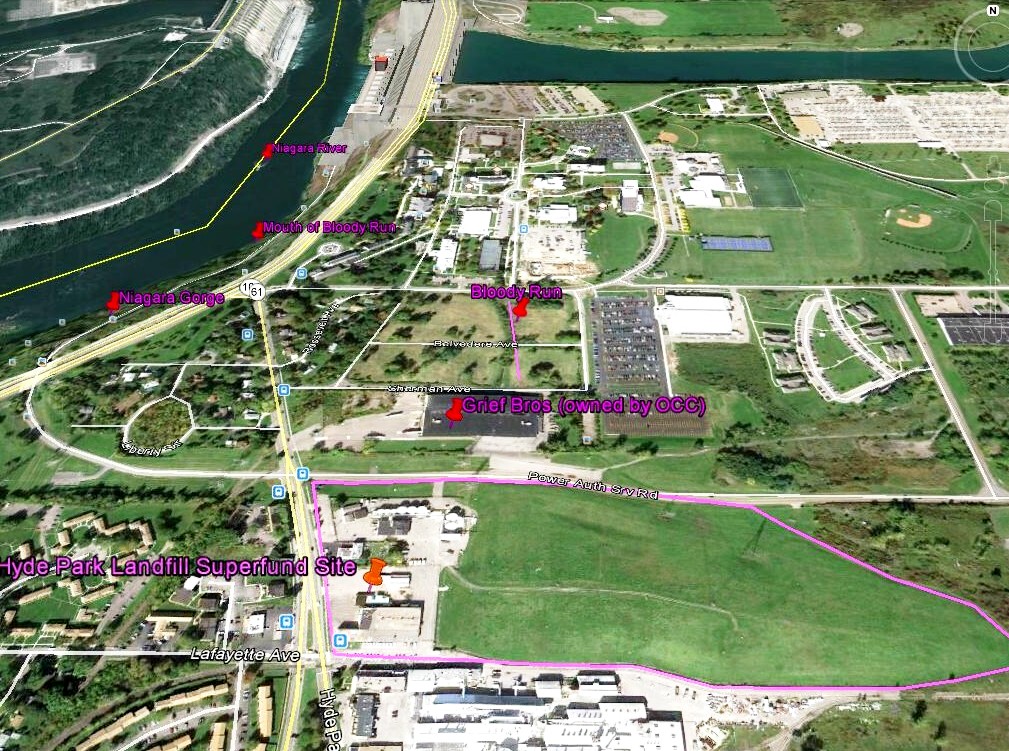
This aerial shot, courtesy of the EPA, shows the mutli-acre Hyde Park hazardous waste dump in the lower right corner and the Niagara River in the upper left corner. Click on the image to blow it up for a better view.
Word that the Hyde Park site –often described as a toxic time bomb when it first came to public attention more than three decades ago – might be removed from the U.S. Environmental Protection Agency’s Superfund National Priority List has been circulating for more than half a year now and has raised concern among environmental officials in Canada and among residents on both sides of the Canada/U.S. border.The main concern is that this site, where some 80,000 tonnes of dioxin and other chemical poisons remain buried, will no longer get the remedial attention required from keeping it from once again leaking these poisons to the Niagara River and Lake Ontario.
However, Gloria Sosa, an EPA remedial project manager, told Niagara At Large in a phone interview from her New York City office that there is “no way” her agency or other parties, including the site’s owner, the Occidental (former Hooker) Chemical Corporation, will “walk away” from U.S. court-ordered responsibilities to monitor, repair or replace the containment structures put in place to keep the dump from leaking.The delisting of Hyde Park from a Superfund list of sites requiring cleanup is “purely an administrative function,” to U.S. Congressional representatives know that cleanup efforts have been successful. “It doesn’t mean that we walk away from the site.”
A court-negotiated agreement the EPA and State of New York reached with Occidental in the early 1980s for cleaning up the site requires all parties to ensure the buried wastes remain contained and are not leaking for generations to come, Sosa said. The Hyde Park site was placed on EPA’s then newly created Superfund site for priority attention in 1983 and ranked in the top ten worst sites of many hundreds across the country that made the list of that time.
Jim Bradley, Ontario’s Minister of Environment and an MPP for the Niagara, Ontario riding of St. Catharines, told NAL in a recent interview that any delisting of a toxic waste site as large and potentially leaky as Hyde Park, and upstream from a water resource shared by millions of Canadians and Americans, is a concern to him.
“Hyde Park was and remains a very toxic site with the potential to leak into a major waterway,” said Bradley, adding that EPA and other responsible parties must make it a priority to keep the site’s buried wastes walled off from the Niagara River and Lake Ontario forever, if need be.
The Occidental/Hooker corporation, a century-long manufacturer of chemicals in Niagara Falls, New York, trucked its toxic wastes, including roughly a tonne of highly-poisonous dioxin, to this site from the early 1950s to about 1975. The site, located a few thousand feet from the Niagara River Gorge and just upstream from the Queenston-Lewiston Bridge, did not contain leak-proof liners and sat on highly fractured bedrock that allowed the wastes to creep through the cracks to the Niagara River.
By the early 1980s, when U.S. government agencies were going through the courts with Occidental to settle on a cleanup deal, chemicals from this dump could be seen seeping out of the rocky wall face of the Niagara River Gorge and what Canadian federal scientists called “fingerprints” of those Hyde Park poisons were concentrating in the flesh of fish in Lake Ontario and even in beluga whales many hundreds of kilometres away in the lower St. Lawrence River.
Doug Hallet, who was an Environment Canada scientist in the 1980s, said at the time and ears later to this reporter that the Hyde Park site is a dump with no bottom, containing wastes that can remain toxic for hundreds of years. He once testified in a U.S. court for excavating and destroying the dump’s wastes rather than leaving them there, but Occidental argued it would not be safe and would prove too costly to do that.
The Hyde Park site became so infamous by the early 1980s that it was featured in a 1982 article in Rolling Stone Magazine. “Experts say that this toxic time bomb’s potential to poison is so great it could yet make Love Canal look like a poison-ivy epidemic by comparison,” the article stated. “For the herring gulls, the fish and the 5.5 million (American and Canadian) people waiting for the Hyde Park time bomb to explode, the unlikely possibility of a miracle cure (like a bacteria capable of eating the dioxin and other buried wastes) is really at hand may be the best – and last – hope.”
Earlier this year, Environment Canada sent the EPA a letter of concern, noting that levels of chemicals known to be buried in Hyde Park, have recently increased in concentrations in freshwater mussels retrieved from Niagara River waters downstream from the site and tested in Canadian labs.
Sosa said EPA is aware of these tests and believes the chemicals may be “residual” waste left over from leakage into an old Niagara Gorge creek called Bloody Run and other fractured rock from many years ago.
She said her agency is sure, based on continued monitoring in and around the Hyde Park site, that the drains, liners, wells and other structures installed in the 1980s to contain the wastes are working successfully to keep any further poison from leaking out, and the agency will continue overseeing containment systems at the site and reporting to the public for generations to come, if necessary.
For our readers information, Niagara At Large is posting the EPA media release on the delisting of Hyde Park site below. The release includes links you can click on for further information and we will have more to say about this issue in the days and weeks ahead.
EPA Removes Hyde Park Landfill in Niagara Falls, NY from Superfund List
New York, N.Y. – November 4th, 2013 – The U.S. Environmental Protection Agency has finalized its decision to remove the Hyde Park Landfill site in Niagara Falls, New York from the Superfund National Priorities List of hazardous waste sites after a successful cleanup. The ground water and the sediment in Bloody Run Creek and Niagara Gorge Face were contaminated with volatile organic compounds, which can cause serious harm to people’s health. The EPA concluded that the work to reduce contamination in ground water and creek sediment has eliminated the threat to public health and the environment. Monitoring conducted over the past 20 years and continuing today confirms the effectiveness of those actions.
The 15-acre site was used from 1953 to 1975 to dispose of approximately 80,000 tons of chemical waste, including dioxin. The site was added to the Superfund list in 1983.
The cleanup included capping the landfill and areas around its perimeter to prevent water from flowing through it and constructing a system to collect and treat the contaminated oily substance leaching out of the landfill. In addition, ground water is pumped inwards toward the landfill and then treated to prevent contamination from spreading to surrounding bodies of water. The ground water, which continues to be treated to reduce contamination, is not used for drinking water. The contaminated sediment in Bloody Run Creek and Niagara Gorge Face was removed and the cleanup work at the site was completed in September 2003. The cleanup work was conducted by the Occidental Chemical Corporation, the company responsible for the contamination, with EPA oversight to ensure that the actions taken were effective and protective of people’s health.
Ground water is sampled quarterly and the EPA reviews quarterly and annual sampling reports to determine that the cleanup goals have been met. An environmental easement that imposes restrictions on the use of the property to prohibit building or any other activity that could potentially damage the cap was placed on the property in 2010. The EPA has concluded that the cleanup work has been effective and that the site can now be taken off of the Superfund list.
The Hyde Park Landfill will continue to be monitored by EPA and remains eligible for cleanup work in the event that a change in site conditions should warrant such an action.
A Notice of Deletion was published in the Federal Register on October 23, 2013. The deletion of Hyde Park makes a total of four sites in Niagara County that have been deleted from the Superfund list. Previously, the Love Canal, 102nd Street landfill, and Niagara County Refuse sites were removed from the list after successful cleanups were conducted.
Information on the Hyde Park Landfill site can be found at the EPA’s website for the project at http://www.epa.gov/region02/superfund/npl/hookerhydepark/.
If residents have questions about the site, they can contact Community Involvement Coordinator Michael Basile at (716) 551-4410 or at basile.michael @epa.gov.
Follow EPA Region 2 on Twitter at http://www.twitter.com/eparegion2 and visit our Facebook page, http://www.facebook.com/eparegion2.
(Niagara At Large invites you to share your views on this post below. Remember that we only post comments from individuals who also share their first and last names.)
 Niagara At Large
Questions for Bradley et al……
1) Do we have access to the test reports referred to in this piece? Are they published? I tried to find them but could not.
2) Has an INDEPENDANT body conducted its own research? Not that I would suspect the US government of behaving covertly…..but that would be interesting to know.
3) Does our government proactively test species other than mussels? Does it test the water itself? It would seem to me that given the flow of water down this river that if concentrations of these poisons were higher in the proximity of that…..
4) I own acreage…. 15 acres aint much. 80,000 tons of waste on 15 acres !!!! I am not a scientist, nor close to it, but that sounds a tad much for 15 acres to absorb.
Makes me wonder why cancer runs rampant in this area….
Just sayin…..
A Brief Response to Greg’s comment from Niagara At Large publisher Doug Draper
There may be some who question the information in my post on the Hyde Park site, but let me assure you that there are truckloads of information, all made publicly available through the U.S. courts and through agencies on both sides of the border, including the Ontario Ministry of Environment, Environment Canada, New York State Department of Environmental Conservation and U.S. Environmental Protection Agency that speaks to the threat this site potentiall poses to the waters, wildlife and people of the Lake Ontario, St. Lawrence River systems if this site is not properly contained.
Among other things, this landfill site contains the largest single volume of the deadliest strain of dioxin – the most potent ingredient in the Agent Orange defoliant deployed during the War in Vietnam – and Canadian scientists who are expert on this chemical have stated, for the record, that a couple of shovels full of this compound dumped into Lake Ontario could lend to concentrations in water columns and fish that may exceed safety standards for drinkability and consumption of fish from the lake, particularly for children and women of child-bearing age.
Mr. Middleton, all of this information is well documented and the volume of information on this infamous dumpsite could fill a room in a library.
So regardless how jaded anyone may be around government, or Jim Bradley or environmental agencies in the United States, the scientific data is there and has been accumulating on this site for 35 years. Then again, if you have joined the war on science, that won’t impress you either. And if that is the case, what more can one say.
LikeLike