
By Mark Taliano
The current trajectories of Canada’s predominant political economies are increasingly dysfunctional, due in no small part to the fact that we have become, in many respects, a petro state, rather than the much vaunted “Energy Superpower” that we were promised.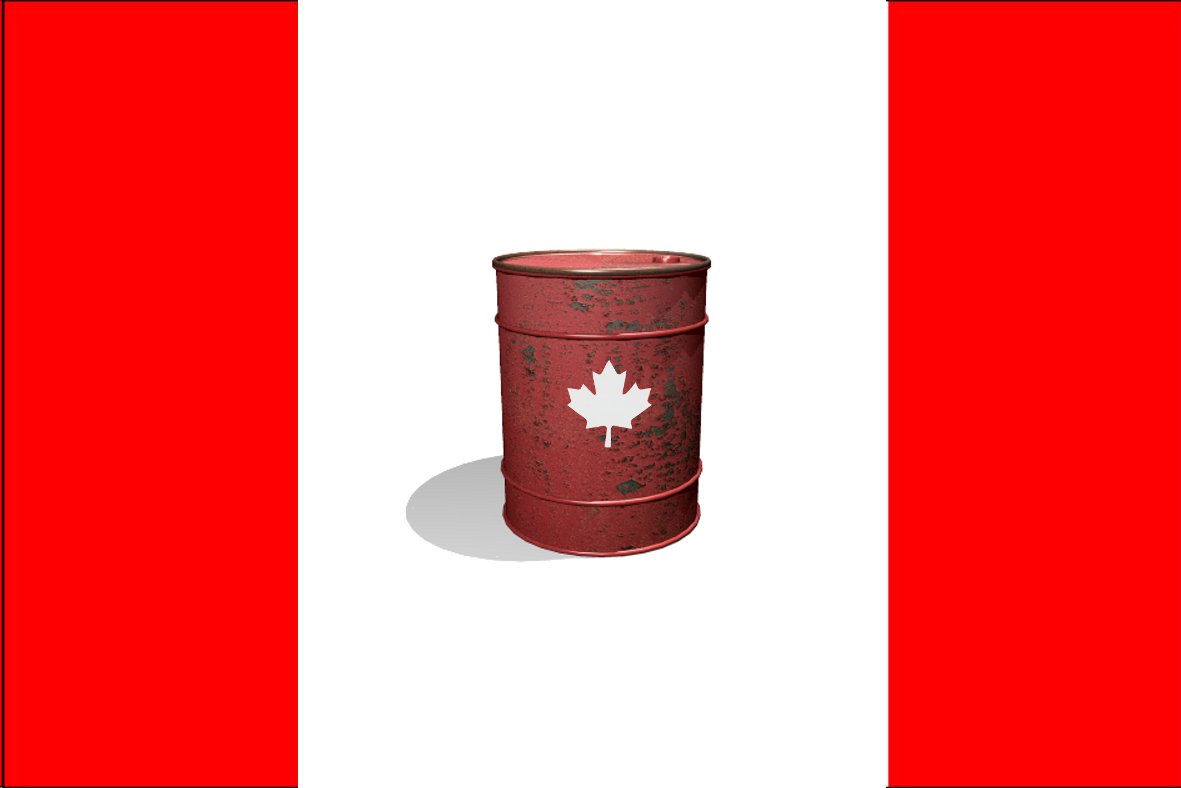
A petro state, as defined by Bruce Campbell, executive director of the Canadian Center for Policy Alternatives (CCPA) in an article entitled, “Norway manages its oil wealth much better than Canada does” is “dependent on petroleum for 50% or more of export revenues, 25% or more of GDP, and 25% or more on government revenues”.
While Alberta is not a sovereign nation, it does qualify for “petro-state” status under these criterion. So does Norway. But the differences between the two polities ends there.
While Norway manages its resource wealth extraordinarily well, Alberta, — and Canada by extension – does not.
One significant difference is savings. Norway has a savings fund, known as a “Sovereign Wealth Fund” which is worth about $656 billion for a population of under 5 million people.
Alberta’s Heritage Trust Fund, on the other hand, is worth a relatively paltry $16.6 billion, for a population of about 3,847,100 people.
The differences in the sizes of these savings funds has far-reaching impacts. As author Terry L. Karl explains in “Understanding The Resource Curse”, a country (such as Norway) that diverts its resource revenue to a savings fund, is necessarily compelled to use its tax base for government funding. Consequently, citizens pay higher taxes, but the politicians represent those who pay the bills (the citizens) rather than representing the insular interests of oil-producing corporations, to the detriment of the public sector, and democracy.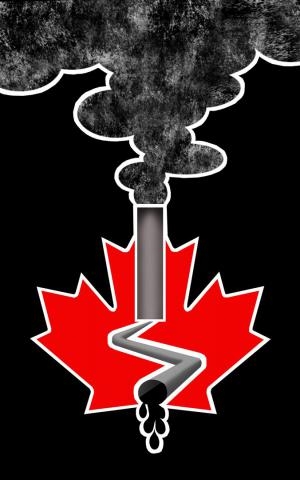
Unlike Norway, Canada, is quite dependent on its resource revenues for government funding. About 40% of Canada’s resource revenues go to Ottawa, and about one third of Alberta’s bills are paid by oil and gas revenues. According to Karl, these differences explain why Alberta’s tax rates are so low, (the lowest personal taxes in Canada) and why its governance is more top down, corporation oriented. As long as taxes are low, people remain relatively disinterested in issues of governance. In the 2008 elections, 60% of eligible voters in Alberta stayed home.
There are other significant problems which are generated by this dependency on resource revenue. One of them is wealth distribution.
Stephen Leahy explains in“The Bigger Canada’s Energy Sector Gets, The Poorer People Become” that economic markers can be deceiving. Consider statistics for Gross Domestic Product (GDP), which is a measure of economic activity. The GDP averaged about $600 billion per year in the 90’s and by 2012 it had increased to $1.7 trillion. On the surface, this seems laudable, but little of the wealth stayed in Canada, and what did stay went to a small percentage of the population. Consequently, income inequality has also increased.
Similarly, our reliance on the boom/bust cycle of resource revenue funding (without setting aside sufficient funds) means that governments habitually overspend. Resource rich Alberta has run a deficit for the last six years running.
This boom/bust revenue model, a hallmark of neoliberal economic theory, impacts the whole country. Safety, environmental, and human rights have become less important; international efforts to address global warming, such as the Kyoto Protocol, and the United Nations Convention to Combat Desertification (UNCCD) have been rejected; real science is now seen as an enemy to overcome; and democracy is an inconvenience.
Our mixed economy is also being decimated. Leahy explains that from 2000-2011, the oil and gas sector created about 16,500 jobs, while, at the same time, Canada lost 520,000 manufacturing jobs.
Much of the manufacturing losses are tied to the rise of the petro-dollar which tends to rise and fall with the price of petroleum. Ten years ago, the Canadian dollar was worth about 65 cents relative to the US dollar. Now both dollars are at about the same level. This parity negatively impacts exports and, therefore, the manufacturing base.
Even Industry Canada acknowledges the problem. Their report notes that between 2002 -2007, from 33%-39% of Canadian manufacturing job losses are due to “resource-driven currency appreciation.”
Despite the overarching negatives, including job losses and deficits, trajectories of Canada’s reigning political economies have remained unchanged. Continued on-the-ground realities, however, may force the government’s hand. Sources as varied as the International Energy Agency (IEA), HSBC, the Conference Board of Canada, and the International Monetary Fund (IMF) are increasingly concerned about Canada’s misdirected obsession with extreme energy extraction.
The International Energy Agency’s (IEA) World Energy Outlook states that “no more than one third of proven energy reserves of fossil fuels can be consumed prior to 2050.” (barring the unlikely and exponential growth in carbon capture storage strategies)
The HSBC Global Research Report (2013) cautions investors about capital intensive extreme resource extraction such as bitumen extraction, and recommends instead low cost companies with a “gas bias”.
The Conference Board of Canada in an article entitled “Opportunity Lost? Alberta is Facing Short And Long Term Financial Challenges Despite its Oil Wealth” observes that Alberta is facing a $4 billion budget deficit, and recommends a “more sustainable fiscal model”
Meanwhile, the International Monetary Fund (IMF), recognizing the imperatives of transitioning to a low carbon world, is urging nations to slash carbon subsidies —- which would drastically slow bitumen extraction developments.
Unlike Norway, Canada’s economic and political self-determination is already curtailed by NAFTA, and by the time Harper’s next suite of corporate empowerment treaties (FIPPA, CETA etc.) are ratified, our ability to determine better political economies will be further hamstrung.
However, despite the restrictions, there still remain some possible alternatives to our current self defeating political economy.
The Pembina Institute, paralleling views of the IMF, argues that the $1.3 billion in subsidies handed out to the oil and gas industries would be better spent on transitioning to clean energies, as it would create 18,000 more jobs as well as “a healthier economy, and a cleaner environment.
Meanwhile, Shannon Stunden Bower, Research Director for the Parkland Institute, advises that Alberta needs to raise taxes: “Alberta,” she explains, “could collect nearly $11 billion more in taxes and still remain the country’s lowest tax jurisdiction.”
Clearly Canada’s economic direction, which is to increase rather than decrease extreme energy extraction, is hitting the wall.
Evidence shouts that we should be transitioning to a low carbon model. Creating a strong Federal Savings Fund, reducing carbon subsidies, and increasing taxes in certain jurisdictions (like Alberta and New Brunswick) would be a start, but we also need more evidence-based policy making, and therefore different governance.
The longer we wait before the inevitable and necessary transitions, the more it will cost.
Mark Taliano is a Niagara, Ontario resident and contributor to Niagara At Large. Click on ‘Be A Contributor’ at the top of NAL’s home page at www.niagaraatlarge.com to find out how you can be a contributor too.
(Niagara At Large invites all those who dare to share their real first and last name to join below in commenting on this post.)
 Niagara At Large
I totally agree with everything in this article. What Harper is doing is:
1) putting all our eggs in one basket (very poor investment model)
2) funneling a large part of our taxes toward a part of our economy that is backward thinking with no futures prospect
3) allocating our growth to just one area of Canada
LikeLike
Mr Taliano: I was actually reading your article and thinking that you had made some very interesting and valid points.
And then you did it again. WTF is a neoliberal????????????
I stopped reading when I hit that one.
For Christ’s sake man, drop the f’ing socialworkerspeak!
LikeLike
Will…it is not “socialworkerspeak” but born of economic philosophy. It is the belief that pure market forces or unfettered capitalism is the best way to go. That is the Harper philosophy which is very dangerous in my opinion. In many ways it is analogues to libertarian ideas where the best way to move forward economically is to be an island unto oneself without realizing that we cannot “be” without others also “being”. As is seen in all of life, there is an interdependence.
LikeLike
Will, Google the word, or just skip it and read the rest of the article, unless you’re too angry, in which case, DO NOT read the rest of the article.
Here’s one definition from Naomi Klein: “…policy trinity (that includes) the elimination of the public sphere, total liberation for corporations, and skeletal social spending…”
In more concrete terms: it means a ridiculously over-priced P3 hospital in Niagara, where taxpayers like you and me are looted by the so-called “private-consortium” / “partners” who get a guaranteed and very inflated price for “services rendered” by “partnering” with the (fleeced)tax payer to build a hospital.
LikeLike
It is still socialworkerspeak … in other words … the use of semi-fake large words designed to make you sound intelligent when in actual fact you are talking through your hat.
LikeLike
Perhaps I should compare Mr Taliano to that other windbag who likes to use large words in order to make himself sound smart — Conrad Black.
LikeLike
Will…your statement says more about what you think of social workers than the actual word “neoliberal” itself. Perhaps the words “unfettered capitalist” would suit you better. Nevertheless, the message is still the same.
LikeLike
I never liked the word myself, but it is a common and legitimate word, although I believe corporate word spinners designed it to be intentionally confusing (FUD-speak). Here are some other words that mean roughly the same thing: neoconservative, unfettered capitalism, fundamentalist capitalism, predatory capitalism etc. Whatever you want to call it, it kills democracy, the middle class, economic and political self-determination, and most people’s bank accounts. How many people lost their savings due to the last economic crash (2008), the recession, the public bailouts of the corporate sector? And the laws governing the unregulated speculative financial system still have not changed? It’s insane. (Will, I thought we were supposed to be polite and not indulge in sand box name calling.)
LikeLike
neo-liberal
1.
relating to or denoting a modified form of liberalism tending to favour free-market capitalism.
In this case, an individual or group that doesn’t care what or who gets hurt in the name of profit.
LikeLike
Climate Change is real and now. Not only is the extraction of bitumen very expensive and dirty, the loss of boreal forests compounds the problem, also the contamination and destruction of the Athabaska marshes and wet lands, and the destruction of water itself, turning it into toxic pools is an outrage. I am appalled that the Corporations responsible for this are allowed to put prime time false advertising on the CBC claiming habitat restoration, future prosperity, and a glowing future for all, when the reality is a grey lifeless wasteland, increased health problems downstream from polluted water, and rip-off profits for the Oil industries. We are being deliberately deceived at our own expense. I thought there was a law against false advertising. It needs to be enforced. We need the truth,
LikeLike