
A News Commentary by Niagara At Large publisher Doug Draper
At least one party is applauding an announcement by the Ontario government this October 25th to strengthen animal protection rules in the province.
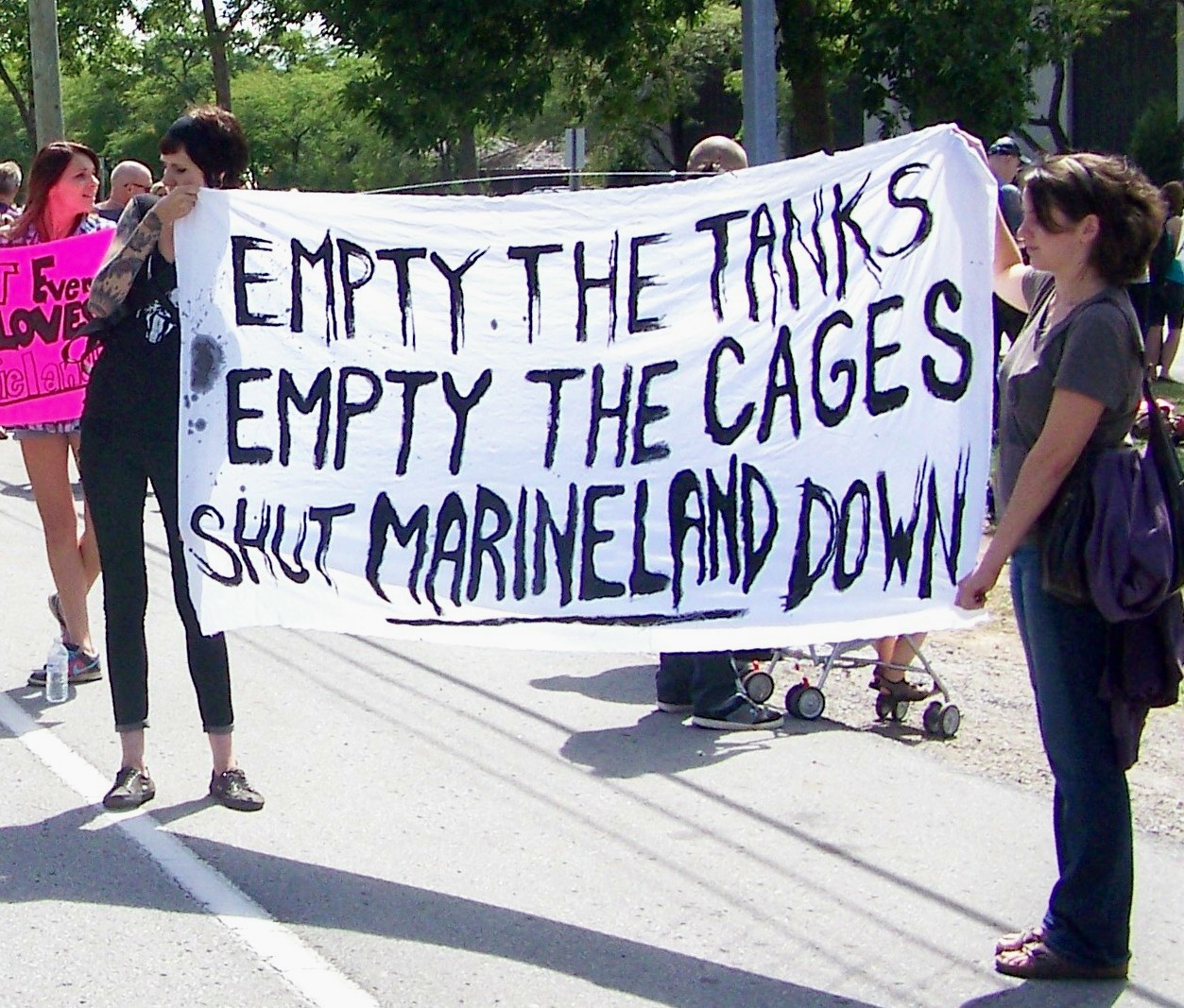
Animal activists demonstrate in front of Marineland in Niagara Falls, Ontario. File photo by Doug Draper
Marincland Canada, the owner and operator of a huge amusement park in Niagara Falls, Ontario that showcases whales, deer and other marine and land animals, said in a prepared statement released short after Community Safety Minister Madeleine Meilleur’s announcement that Marineland “weclomes … her decision to seek independent scientific advice in the establishment of appropriate standards of care for marine mammals.”
Marineland’s statement went on to say that “the well-being of our animals and mammals has, and always will be, our first priority. Our dolphins, whales, sea lions, walruses, deer and bears are what attract the tens of millions who have watched our shows and visited our attraction. Like us, our visitors want to ensure those animals and mammals they love are well cared for and we are confident the establishment of transparent standards of care will provide that assurance and in the process ensure the long-term and ongoing success of Marineland.”
John Holer, founder of the five-decade-old Marineland park, marketed for many of those years as the most popular tourist attraction next to the roaring Falls s themselves, made these same statements well-being of the animals he keeps in interviews with this journalist going back some 20 years.
“I would be the biggest fool walking on this earth if I did not take care of these animals,” Holer told me in one 1992 interview. “I couldn’t afford to lose these animals.”
According to critics of the park, however, Holer has lost quite a few animals over the years, including orcas (more popularly known as killer whales), beluga whales and dolphins, well before what many marine biologists believe would have been their expected lifespan in the wild. animal activists who are convinced that marine animals like whales and dolphins should not be displayed in cement pools for our entertainment are not likely to be satisfied with the sketchy plans for stronger protection measures outlined in Meilleur’s October 25th announcement.
Meilleur promised to review Ontario’s animal protection measures following a series of Toronto Star stories in 2012, reporting allegations by former Marineland employees about conditions for animals at the park. In one of the articles she is quoted saying she was “very concerned” about the allegations featured in the Star series. “I was in tears,” she said before acknowledging that she would have preferred to find out about the Marineland situation from the Ontario Society for the Prevention of Cruelty to Animals (OSPCA), an agency under her ministry, rather than read about them in a newspaper.
Later in the series, Meilleur expressed surprise by a Toronto Star revelation that the OSPCA does not apply as much scrutiny to a zoo or aquarium if the operation retains a veterinarian to look in on animals, even if that veterinarian is not specialized in dealing with the specific animals in question
In other words in Ontario, the rules are such that you can have a vet who spends most of their professional time caring for dogs and cats tending to whales or dolphins on a freelance basis. One might ask that if Meilleur did not know about that – what she went on to suggest might be a “loophole” in the province’s animal protection programs, what else doesn’t she know?
One might also ask of her October 25th announcement, what is the point in granting the OSPCA an additional $5.5 million in provincial funding each year if a couple of reporters at a newspaper does a better job of informing a minister of the crown of possible problems at a major animal-handling operation in the province than it does?
Further to this, what can we make of these new requirements to have the OSPCA do at least two inspection visits at zoos and aquariums in Ontario each year? Will these be surprise visits or will they be scheduled with the operator in a way that allows enough time to clean up sweep away any possible problem before the inspectors arrive?
Who will be chosen to sit on this special panel for reviewing and possibly reforming the province’s animal protection standards? Please spare us from choosing representatives of the Canadian Aquarium and Zoo Association, a commercial body with zoo and aquarium operators as their members. This group is burdened with obvious conflicts of interests that have it going through a member’s facilities with blinders on.
On that note, stay away from local humane societies that are largely funded by municipalities that have a vested interest in the commercial success and popularity of zoos and aquariums in their jurisdiction
Along that same line, what is the full meaning of a statement in Meilleur October 25th media release which reads; “In developing the final regulatory standards the economic and tourism impact of these standards on affected communities will be considered.” Let’s hope this isn’t code for assuring zoos and aquariums and the municipalities they operate in that if it comes to a choice between the welfare of the animals and the commercial interests of the zoo or aquarium operation, the zoo or aquarium will come first.
One could go on to ask why Meilleur isn’t already doing what other jurisdictions around the world are doing and order zoos and aquariums to release to governments and the public detailed reports on the death of animals in its care. We shouldn’t have to read stories in newspapers that speculate on the number of belugas that have died at a facility like Marineland within the past year.
Why has no open consideration been given by the provincial government to ban the import of whales like belugas – whales that are banned from capture in Canadian waters yet are captured in waters outside of Canada – from other parts of the world.
I am sure animal activist groups will be responding to Meilleur’s announcement with many comments and concerns of their own in the weeks and months ahead and Niagara At Large will update our readers on them.
In the meantime, we are posting below the October 25th media release outlining Meilleur’s announcement.
Ontario Strengthening Protection for Animals
Province Taking Action to Enhance Animal Welfare
October 25, 2013, Ministry of Community Safety and Correctional Services
Ontario is strengthening protection for animals through regular inspections of zoos and aquariums, by boosting enforcement of animal welfare laws, cracking down on puppy and kitten mills, and enhancing standards of care for marine mammals.

Ontario Community Safety Minister Madelleine Meilleur
With support from the Ontario government, the Ontario Society for the Prevention of Cruelty to Animals (OSPCA) will strengthen protection for animals by:
- Enhancing the responsiveness of investigators to animal welfare complaints from rural and northern communities.
- Establishing a 24-7 centralized dispatch service to ensure enforcement officers can respond effectively to calls about animal abuse from anywhere in the province.
- Creating a squad of specially trained investigators who will crack down on puppy and kitten mills.
- Delivering specialized livestock training for investigators in the agricultural sector.
The OSPCA will also enhance protection for animals in captivity by:
- Conducting regular inspections of zoos and aquariums to ensure the health and safety of animals.
- Establish and maintain a registry of zoos and aquariums to support twice-yearly inspections.
The province will also be seeking technical advice from the scientific community regarding standards of care for all marine mammals, including whales, dolphins and seals. In developing the final regulatory standards the economic and tourism impact of these standards on affected communities will be considered.
Working to protect animals from abuse and neglect is part of the government’s plan to work together as One Ontario to address the unique needs of every community, so that we can build a successful, compassionate and united province.
Quick Facts
- Ontario is providing the OSPCA with $5.5 million annually to strengthen protection for animals. OSPCA will also provide regular progress reports to government that demonstrate how it’s delivering on these enforcement initiatives.
- The Ontario Society for the Prevention of Cruelty to Animals Act was last amended in 2009, making it the strongest animal welfare legislation in Canada.
- There are over 60 zoos and aquariums in Ontario — more than any other province.
Quotes
“Our government cares deeply for the well-being of animals wherever they live in this province. These measures strengthen the enforcement of animal welfare laws in under-served areas, dedicate resources to specific areas of concern such as inspections of zoos and aquariums and will set new standards of care for marine mammals.” – Madeleine Meilleur , Minister of Community Safety and Correctional Service
“This announcement begins a new era for animal protection in Ontario. We are pleased and proud to partner with the province on this historic initiative.” -Rob Godfrey, Chair, Ontario Society for the Prevention of Cruelty to Animals
(Niagara At Large invites you to share your views on this post. A reminder that we only post comments by individuals who share their first and last name with them.)
 Niagara At Large
It seems to me one thing we should do is educate our young people into realizing capturing mammals from their natural habitant of the oceans and placing them in aquariums is cruel and we do not want to be part of encouraging this torture by paying to bring our children to watch this unnatural spectacle. If Marinelands and Sea Worlds do not make a lot of money, their businesses will die a natural death.
LikeLike
If inspections are conducted via scheduled appointments then this is a useless waste of time and money. If the scrutinizing board members are appointed from obvious groups with conflicts of interest due to their affiliation with those who need to be held to transparent standards of compassion, health and safety concerns then this is also a waste of time and money. If the quote: “so that we can build a successful, compassionate and united province” had been structured: “so that we can build a compassionate. united and successful province”, then there could be more hope that this may not turn out to be a white-washing effort aimed at appeasing those who have finally been able to expose such horrific facts. There are some great amusement parks and water parks that do not have any non-human slaves providing any form of entertainment. Those places provide jobs and community affluence along with some nice donations to the tax collectors. So when the first greedy person claims that their community will suffer financial woes if they are forced to stop the exploitation of their non-human slave stock, they will need to simply make the adjustments. Change is more difficult for some and easier for others but we have evolved and will continue no matter how much kicking and screaming is done. One of the first things that should happen is to completely ban the import of any marine mammals and other creatures used for so called entertainment and back the ban with huge monetary and imprisonment penalization. Also include a ban on the breeding of any who are already in captivity to insure the closing of that loophole. With any luck the puppy and kitten mills will get completely abolished if a similar heavy duty penalization standard becomes compulsory. Compassion should not be such a difficult journey to take. Some of us were born knowing the path and will stay steadily on it no matter how many protest events it takes.
LikeLike