
Submitted to Niagara At Large by the Canadian Centre for Policy Alternatives
(A brief note from NAL – To the extent that Niagara, Ontario and our neighbours across the Niagara River in Western New York have rail trains carrying hazardous materials through our regions and communities, this is something we should all be concerned about.
By the way, if Canada’s Harper government feels that deregulating safe practices in the rail transporation industry is okay and we subsequently suffer a disaster like this, why should we trust this same government around responsible federal safety and monitoring rules for the piping toxic goo from the Alberta tar sands through our Great Lakes region.)
OTTAWA, October 22, 2013 —A study released today by the Canadian Centre for Policy Alternatives (CCPA) points the finger at corporate negligence and regulatory failure as root causes of the Lac-Mégantic disaster.
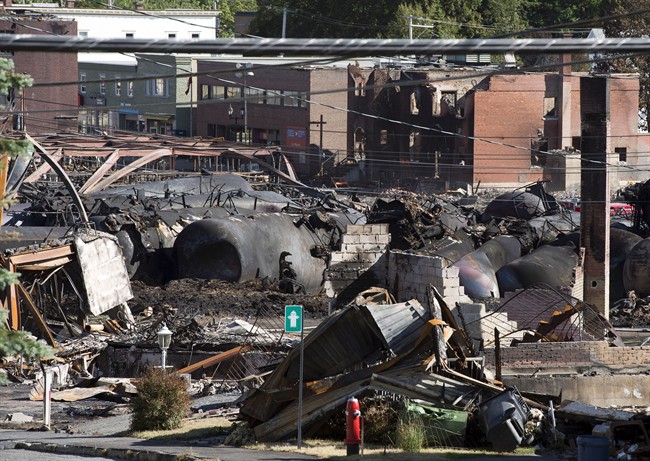
A train disaster that cost lives and ravaged a community
According to the study, by CCPA Executive Director Bruce Campbell, the evidence to date suggests a flawed regulatory system and cost-cutting corporate behavior that jeopardized public safety and the environment, with the chain of responsibility extending to the highest levels of corporate management and government policy-making.
“Barring new evidence, it seems Montreal, Maine and Atlantic, an admittedly poor performer compared to other companies, simply took advantage of the freedom granted by the regulatory system,” says Campbell.
The last five years have seen a wild-west boom in the transportation of oil by rail. Close to 275,000 barrels of crude oil per day are now shipped by rail in Canada—up from almost none five years ago. And yet, Transport Canada’s Dangerous Goods division budget has remained extremely small—$13 million to cover all modes of transportatio
“It has only 35 inspectors, the equivalent of just one inspector for every 4,000 tank carloads of crude oil transported in 2013. In 2009, when the oil-by-rail boom started, there was one inspector for every 14 tank carloads,” Campbell says.
The study also finds that, despite the dramatic rise in oil shipments, the government cut the rail safety division’s budget by 19% from 2010 to 2014.
The study points to several other flaws in the regulatory system, including:
- The Transport Minister granted Montreal, Maine and Atlantic an exemption from the required two-person crews, one of only two exemptions granted for a freight railway—despite objections from the union representing workers and a troubling safety record—possibly due in part to pressure to adopt the lower US standard, which permits one-person crews.
- Until Lac-Mégantic, Transport Canada did not heed repeated Transportation Safety Board warnings regarding unsafe tank cars, vague brake rules, and rules allowing trains be left unlocked and unattended.
- Amendments to the Railway Safety Act more than a decade ago surrendered authority to companies to develop their own safety management systems—making their own judgments about the balance between cost considerations and the risks to public safety. Referred to as co-regulation between government and industry, this is in effect, self-regulation.
In the months leading up to the accident, industry lobbyists repeatedly advocated against new safety regulations for the transportation of dangerous goods.
“Lac-Mégantic has heightened public awareness of the dangers of huge shipments of crude oil passing through their communities—whether by pipeline or rail,” says Campbell. “The proliferation of oil-linked rail accidents will keep the focus on the need for major regulatory improvement.”
“It is important to keep the spotlight on the flawed self-regulation approach that lies at the heart of the regulatory failure responsible for Lac-Mégantic. The government needs to take back authority ceded to corporations,” Campbell concludes.
The Lac-Mégantic Disaster: Where Does the Buck Stop? is available on the CCPA website: http://policyalternatives.ca.
(Niagara At Large invites you to share your views on this post. A reminder that we only post comments by individuals who share their first and last name with them.)
 Niagara At Large
I have been following this particular issue with a great deal of interest. I have no hesitation in admitting that I am a railfan. I love trains – have since I was a child and I am now in my late 60s.
I do not disagree with the report outlined above. The MM&A is a railway owned by a guy from the United States who will do anything to make a buck. By deferring maintenance on the tracks, the speed limit had to be reduced to 10 miles an hour (railways still operate in miles). The one-man crew is beyond ridiculous! And after the disaster, Ed Burkhardt, the owner of the MM&A threw the engineer “under the bus” by blaming him! Burkhardt has a history of running slipshod operations and running roughshod over employees.
And yes, the federal government does have to bear much of the blame for the way it has reduced oversight.
But at the same time, that reduced oversight is at the behest of taxpayers. Yes, look in your own mirror (and don’t say you didn’t vote for the Conservative government – that doesn’t wash). The simple fact is that Canadian voters chose a government that said it wanted to reduce the size of government. Reducing the size of government means reducing government programs and services.
You want lower taxes? You get fewer services.
You want less government? You get less oversight.
There are some of us who feel we do need less government – but the way to get there is through less useless government spending, such as on the CBC, foreign aid to countries that hate us, tax money going to “professional” sports etc.
Canadian taxpayers collectively have to accept that the reason the government has cut back on monitoring safety is because we, those same taxpayers, have allowed, and even encouraged, them to do so.
I know most readers of NAL will not agree with me — but the fact of the matter remains, the government was elected to reduce taxes etc.
I agree with reducing taxes. But I also disagree with the way it has been, and continues to be, done.
LikeLike
People think this reckless deregulation is good for the economy. Not so.
Alberta has run a deficit for the last six years running. Neoliberal corporate government mismanagement.
LikeLike
What the hell is “Neoliberal?”
This sounds like socialworkerspeak!
A Short Note from Niagara At Large publisher Doug Draper – I applaud you for being the first to ask what this term “neoliberal” actually means. Does in mean ‘fake liberal’, ‘ corrupt liberal’, tea party liberal’, lying scumbag of a liberal’, ….. we could go on … it almost sounds to me, who gave up on the bullshit our schools of higher learning crank out a long time ago, that it is some term that ideologues like Chomsky made up just to pretend they are ahead of the bloody curve of woody allen, upper west side manhattan intelligence or something. So I agree with you. Please spare us from psuedo Chomsky, bullshit terms like ‘neoliberal”. I’m not interested, and I doubt many other people are either, in people who use these terms trying to bafflegab the rest of us into believing that they are smarter than us. Just please try frigging making your case in words that the rest of us who may care can understand.
LikeLike
Will, as an 11 year (age 17 to 28) railroader I can say: If you are going to let companies operate with loose accountability, you can expect them to let inadequately trained employees work with inadequate supervision. I worked for CN when it was a crown corp. in Fort Erie. We used to see rail cars come across the border in terrible mechanical condition. Wheel bearing journal boxes (Before roller bearings) so dry the lubricating pads were tearing into dust. Literally double digit miles away from a hot box and disaster. We saw worn out brake shoes, broken springs and main frame structural damage.
Publically traded companies must show a profit. But not “just” as profit, an increasing profit to satisfy investors who don’t know and don’t care how. So the ultimate objective is to run the thing on air, for free, while charging market rates for shipping services.
Money spent buying political capital is very good value. There is no avoiding this reality no matter which of the 3 main parties govern. I believe I am repeating your main point, Will.
However, I disagree with what you think should be dropped from spending priorities: We desperately need the CBC, though it is grossly manipulated with its budget in the hands of Parliament; What little foreign aide is spent most winds up recycled into Cdn business with few benefits to the receiving country.
Government corruption allows the hemorrhaging of tax revenue into off-shore banking. Domestic tax rates so low government can’t do the job of policing commerce amounts to a private sector subsidy for which the people of Lac-Mégantic paid the price.
LikeLike
Yes Mr Thomas, we do agree on the points regarding rail.
But as someone who spent more than 20 years in private broadcasting, I am of the strong opinion that the CBC, as it stands today, is largely unnecessary. CBC radio does a good job providing service to many areas that would otherwise not have service. But CBC television, where most of the money is wasted, is largely a duplication of what the private sector covers.
LikeLike