
A Commentary by Doug Draper
I picked up a bumper sticker in an independent bookstore called Talking Leaves in Buffalo, New York a few years back that reads ( and there is no typo here); ‘Mall Wart – Your Source For Cheap, Plastic Crap.’

This is my idea for a slogan for cheap t-shirts that might bring a message home. Wonder if anyone would buy it? Doug Draper
It’s a line I am sure most of us can relate to since most all of us have done our share of buying cheap crap in discount marts, whether it be that $5 t-shirt or $10 pair of jeans.
This brings me to the more than 700 workers in Bangladesh who, for wages at or below 20 cents an hour, were producing garments for dozens of North American-based retail chains until late this April when the multi-storey sweatshop they were toiling in collapsed and crushed them to death.
It is sad that it has taken a catastrophe on this scale to finally get more people across Canada and the United States thinking and talking about the deplorable conditions many around the world work in so that we may enjoy the lowest prices possible at some facsimile of ‘Mal Wart’.
Even Galen Weston, a member of Canada’s billion-dollar Weston family empire and the chief executive of Canada’s Loblaw Cos. Ltd which had clothing produced in that Bangladesh plant through its ‘Joe Flesh’ line, came out this May 1 and publicly stated that he was “deeply shaken” by the disaster.
“Our thoughts and prayers continue to go out to those who were injured and to all of the families who have lost loved ones,” said Weston, who went on to discuss setting up some kind of compensation fund for families of the victims.
Well that sounds nice and all, and at least Weston deserved some credit for being one of the few chiefs of some 30 North American-based corporation who had garments produced by those hapless Bangladeshi workers to speak out. Yet at the same time, it is hard to believe that someone as smart as Weston, whose company has been trolling around the world for years, seeking out the cheapest places possible to produce the goods that fill its retail shelves, had little or no idea that tragedies like this, albeit smaller and therefore less publicized than this one, are occurring in numerous impoverished regions around the world every single day.
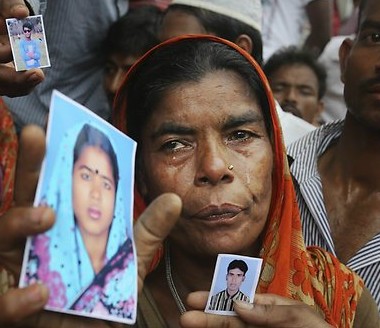
A woman weeps for lost loved ones outside the collapsed garment -making sweatshop in Bangladesh.
In the internet world we live in today, all of us have had the opportunity to learn about the plight of people working in off-shore sweatshops if we care to. I’ll admit, for my part, that it is not something I want to spend too much time thinking about when I am purchasing that $7 t-shirt or $5 package of socks.
Indeed, I’ve heard many a friend or neighbour over the years say something like; ‘You know what. I’m not doing all that well in the pocketbook myself these days. So what can I do? So the lower the cost the better.’
But what is the real cost to ourselves, to our community and country, and to those who are all but tethered (and in some cases are) to benches in some dirt poor area of the world to produce this stuff?
I will take a stab at an answer by beginning with a shopping experience I have had in a place called Provincetown in Cape Cod, Massachusetts. On the main street of that town, called Commercial Street for the many dozens of shops, taverns and restaurants catering mostly to tourists, there is still a store that, up to the last time I visited last fall, at least, was still one of the few along the strip selling t- and sweatshirts made in the United States and Canada. Less than a block away is a chain outlet where you can frequently find t-shirts made in Pakistan and similar places that may sell for as three shirts for 10 bucks.
Seems like a great deal until you start wearing and washing the shirts and find out that a year or two down the road they make good rags for washing and waxing your car before you give them a toss. Meanwhile, those Made in Canada and the U.S. shirts, as much as I paid $5 or $10 more for them, are still in my drawers, looking as good as new five to 10 years later.
A few years back, I gave the owner of the store selling the Canada and U.S. shirts a verbal pat on the back and he told me he didn’t know how much longer he could keep it up for a couple of reasons – there are fewer and fewer garment manufacturers in North America because the larger box chains like Wal-Mart are buying from sweatshops overseas and because so many consumers want those cheap shirts.
What we are talking about here is the continued loss of manufacturing jobs in Canada and the U.S., and the death of a middle class that used to have enough expendable income to buy new homes and cars and other products that kept our local economies humming. We are talking about the demise of a middle class that paid most of the taxes that kept our health care and other services operating at a level that once met the essential needs of every member of our communities.
If we continue down – and I mean down – the path we are now, on, it will get to a point where there will be very few of us left who have enough income to shop anywhere else other than a dollar store. Some out there may say it won’t happen to them, but in this internet world we live in today, virtually any job can be outsourced. They can fire all of the teachers and have students participating in video-cam classes, using ‘go-to-meeting’ or even more sophisticated technology than that, with instructors from India or China if they want. I’d be looking behind my back if I were a lawyer or a consultant in engineering, economic development or any other field too.
I still hold out some hope that enough of us will learn some lessons from the Bangladesh disaster, from a ‘foreign workers program’ in Canada, and from visa programs in both Canada and the United States that have allowed the displacing of Canadian and American workers with cheap labour from other countries, and finally say enough of this ‘globalization’ racket – all geared to favour corporations focused on exploiting the next thing to slave labour in the poorest regions of the world.
I’m still hoping that before it is too late and more of us have fallen down so many rungs of the ladder that we are all working in and buying cheap crap from sweatshops, that we stand up for decent paying jobs on this continent.
Before I hope that at least some of you may join in a discussion with comments of your own on this post, I will leave you with a video from the people at Jib Jab that I featured on this site once before. It just about sums up the cycle of outsourcing North American jobs and being stuck with little left than cleaning toilets for minimum wage on this continent. I urge you to check it out by clicking on http://www.youtube.com/watch?v=pKv6RcXa2UI .
(Niagara At Large invites you to join in the conversation by sharing your views on the content of this post below. For reasons of transparency and promoting civil dialogue, NAL only posts comments from individuals who share their first and last name with their views.)
 Niagara At Large
I always ask where the things I buy are made. I avoid China at all costs. I suggest we all do the same. It’s been my experience that while you might save half, whatever you bought seems to last half as long if not less! Buy Canadian and US if possible. I prefer non-unionized companies because unfortunately they are at the other end of the spectrum (high price/mediocre product).
Keep the jobs here, buy local and you will not only get better products but you will also end up reducing the junk shipped to our landfills.
Just sayin…..
LikeLike
Walmart was ok back in the late 80’s and early 90’S . I hate shopping there any more . One time I took back a non working TV and they took it off the counter and dropped it on the floor. I used to chat with a Walmart supervisor (about how) they where not to spend time with the hourly people after work.
Also I have met many people that have worked at the local warehouse.
On average a person lasts two weeks. But there is a person named Mark and another named Porter. Those two guys can outwork most any person there. Porter retired since he hit a deer and was debilitated . Mark may still work there. The last time I saw him, he looked like he had not aged a bit – 30 or something.
LikeLike