
A Submission from Niagara Recycling
(A brief foreword by Niagara At Large publisher Doug Draper – This not-for-profit recycling organization and partner of Niagara, Ontario’s regional government was one of the first bodies of its kind in the province and the country to launch a curbside recycling program. Niagara Recycling, managed back in those days by Brian McMullan (who went on to become mayor of St. Catharines) and these days by Norman Kraft, has also had a long-time record of giving people with developmental disabilities an opportunity to work.
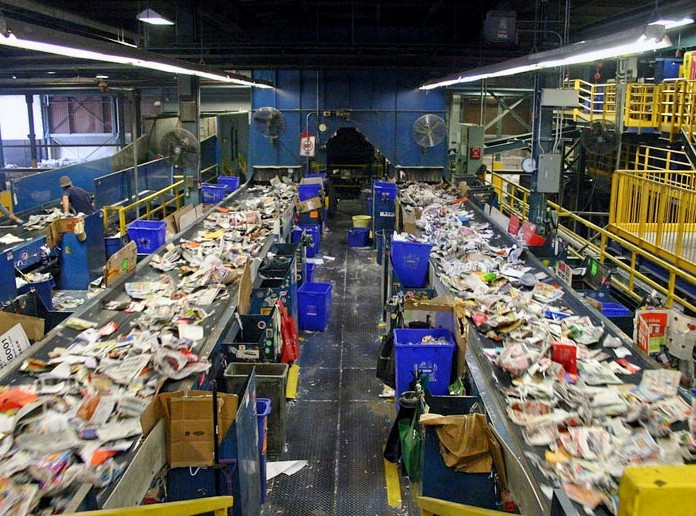
Sorting lines at Niagara Recyclings processing plant in Niagara Falls, Ontario
NAL also wishes to applaud the efforts of Niagara Recycling, along with one of its other long-time regional partners, NTEC, to raise public awareness about individuals and families faced with f autism, and about what we can do as a society to make life better for people living with this disorder.)
Niagara Falls (March 28, 2013) – As Niagara’s leading social enterprise company committed to helping people with developmental disabilities, Niagara Recycling wants to turn the spotlight on a disorder whose rates are said to be steadily climbing in Canada.
It’s estimated that 190,000 Canadian children have autism spectrum disorder (ASD). Studies suggest the rate of autism is increasing. According to Health Canada, one in every 150 to 160 Canadian children has ASD, but some reports put that number at as high as one in 88.
“Supporting people with developmental disabilities, including autism, is the cornerstone of our social mandate,” says Norman Kraft, chief executive officer of Niagara Recycling. “We’d really like Niagarans to be more aware of Autism Spectrum Disorder, and support organizations such as NTEC that provide important services to people living with ASD and their families.”
This year, Niagara Recycling is funding a new $71,000 annual NTEC afterschool respite program at the Donald L. Reilly Centre. Operating 6 hours a day, Monday thru Thursday, 32 weeks per year, the program is providing over 6,000 hours of respite support for families with children aged 5 to 18 years with autism.
“Every family needs a break, and waitlists are far too long. Niagara Recycling is here for the very reason to help provide these kinds of supports and opportunities to families living with developmental disabilities” said Bill McMullan, Board Chair for Niagara Recycling.
Autism is a disorder of the nervous system characterized by impaired social interaction, communication and repetitive behaviour. ASD is a term used to describe a group of developmental disorders such as Asperger Syndrome, Rett’s disorder and Pervasive Developmental Disorders (PDD).
World Autism Awareness Day has been held annually on April 2 since 2008. It was designated by a resolution of the United Nations General Assembly.
As a core part of it’s mandate, Niagara Recycling provides meaningful work-like and life experience for people with developmental disabilities. In fact, the company’s seeds were planted way back in 1970 thanks to the vision of John Brennan, whose objective was to provide employment opportunities to those perceived as unemployable, including his son.
As a result, the Niagara Training and Employment Agency (NTEC) was founded, but Brennan’s bold vision did not stop here. He knew that the only way to ensure that his son’s future would be productive and rewarding, was to create an enterprise where training and employment programs gave rise to real life work experience and community integration. So he launched a recycling collection program in 1974, only the second in Ontario In 1978, this program was growing so rapidly that NTEC spun it off as a non-profit subsidiary company, now known as Niagara Recycling – a name that has become synonymous with recycling in the Niagara region.
Niagara Recycling now sorts over 80,000 tonnes of blue and grey box recyclables collected throughout Niagara at its 100,000 sq. ft. facility in Niagara Falls. Employing 80 full-time employees including four with developmental disabilities and giving work-type experiences to another 12 NTEC participants.
As a non-profit social enterprise, Niagara Recycling, uses all its “profits” to fund social projects. In Niagara Recycling’s case since 1996, the organization has contributed $1.25-million in capital and programs for people with autism and other developmental disabilities and their families, including:
NTEC’s purchase of what is now the Donald L. Reilly Centre in 2000, a former District School Board of Niagara site in Niagara Falls
a summer camp and ongoing research at Brock University for kids, teens and young adults with ASD
an alternative education classroom in conjunction with the DSBN, for children between the ages of 6 and 13 with Autism Spectrum Disorder.
About Niagara Recycling
Niagara Recycling, a non-profit social enterprise company, providing recycling services to more than 140,000 households in Niagara through a 25-year partnership with Niagara Region. The non-profit organization invests its surpluses in NTEC and other initiatives that support families and people with Autism Spectrum Disorder (ASD), and other special needs. Niagara Recycling provides opportunities for people with developmental disabilities through its Waste Management training and employment program. Since 1996, Niagara Recycling has contributed approximately $1.25-million to important social initiatives in Niagara.
About NTEC
NTEC is a non-profit organization that empowers people with developmental disabilities to participate more fully in community life. Its training and employment experience programs were created to provide opportunities for real life and work-type experience, as well as community integration for its participants. NTEC’s sustainable employment and life skills oriented programming has made it a leader in the Canadian social service sector.
(Niagara At Large invites you to join in the conservation by sharing your views on the content of this post below. For reasons of transparency and promoting civil dialogue, NAL only posts comments from individuals who share their first and last name with their views.)
 Niagara At Large