
A Commentary by Doug Draper
A Brief Foreword to this Commentary – With a recent series of articles by Toronto Star reporter Linda Diebel bringing attention back to the questions and concerns over the conditions of whales and other mammals at the Marineland amusement park in Niagara Falls, Ontario, many have asked if there are not better ways to get close to these great creatures without keeping them in captivity.
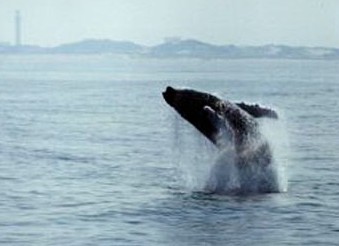
A humpback whale – one of nature’s gentle giants – off the coast of Cape Cod, Massachusetts. File photo courtesy of the Dolphin Fleet.
In the case of whales, dolphins and seals, one option is the many whale-watch excursions that are available on the east and west coasts at a price, quite often, that is less than what many families people who travel hundreds of miles pay at that at Marineland’s front gate.
I was about to write a piece encouraging people to consider whale watches as an alternative to places like Marineland when I looked through the old files of stories I wrote about Marineland when I was reporting on this park as an environment reporter at the late-great St. Catharines Standard two decades ago and thought; why don’t I just reprise this column from October 1996.
As I keyed this 16-year-old column in for posting here, two disturbing thoughts crossed my mind: First, how little things have changed for the animals at Marineland since that time. And second, how unlikely it is that mainstream media in Niagara, including a Standard newspaper now owned by the God-awful SunMedia chain, would be willing to publish the kind of stories and columns I wrote about Marineland back then when the paper was independently owned.
In fact, I was discouraged from writing any more about Marineland and most all other issues related to the environment after Conrad Black’s Hollinger corporation took over the Standard in the late 1990s. Shortly thereafter, I joined many of my reporting colleagues in leaving that paper, as it was already devolving down to the steaming pile of crap that it is today.
At any rate, here is a column I would argue is as relevant today as it was when I wrote it a decade and a half ago, save for a few minor calendar date adjustments I made in the text.
“As we took dominion over the living world, we left behind feeling of kinship with animals and nature.” – Jim Mason, author of An Unnatural Order – Uncovering the Roots Of Our Domination of Nature And Each Other.
Off the sandy shores of Cape Cod, Massachusetts, on a fertile marine sanctuary of the Atlantic called Stellwagen Bank, the engines of the Dolphin VI rumbled to a halt.
“Oh look daddy,” whispered my wide-eyed daughter Sarah as more than a hundred others on the Dolphin VI cast their eyes across the vessel’s starboard side.

A Dolphin Fleet whale watching vessel heading for marine sanctuary waters off the coast of Cape Cod.
There, beneath the steel-blue skies of a late –summer, New England afternoon a humpback whale – one of Earth’s largest and most wondrous creatures – glides gracefully by.
For a moment, everyone lined the upper and lower decks of the whale-watching boat stood motionless and quiet. Then a tall fellow near the stern of the boat pierced the silence like a whaler’s harpoon.
“Come on,” he bellowed as he brandished a camera in the direction of the whale. “Dive for me so I can get a shot of your tail.”
As much as the man’s outburst sullied the spirit of the moment, I almost felt sorry for him as others turned and a displeasing glance his way as if he had violated the sanctity of a church. He may have been the odd person out on this journey into the natural world of whales where (from my experience on these excursions) a majority of the passengers tend to embrace a more passive, let-it-be stance to these creatures.
But back on the mainland, where natural worlds are being turned into subdivisions and strip malls at a relentless pace, I suspect that far more people – maybe even a majority of the human population in our so-called more civilized Western world – believe other creatures should be there for us to use in whatever way we see fit.
John Holer seems to know this instinctively and has built a multi-million-dollar empire pandering to peoples’ desire to watch animals perform for them at his Marineland amusement park in Niagara Falls, Ontario.
For more than 50 years now, Marineland has lived up to its hype as one of the biggest attractions next to the Falls, drawing hundreds of thousands of visitors, including 50,000 school children each year.
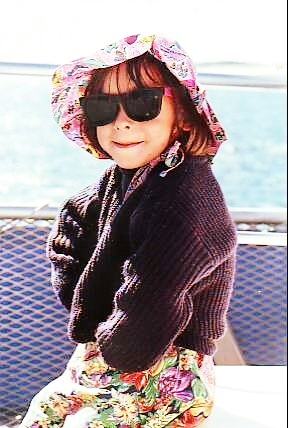
My daughter Sarah Draper, then five years old, off on her first whale watch journey off the coast of Cape Cod, Massachusetts. She has never shown any interest in going to Marineland. Photo by Doug Draper
A highlight for many is the park’s King Waldorf Theatre, where trainers manoeuvre whales and dolphins through a routine of circus –like acts.
Marineland has its detractors, of course. Groups like Zoocheck Canada of Toronto, the Canadian Federatin of Humane Societies of Ottawa and the locally based Niagara Action for Animals have been holding demonstration in front of the park for the past five years (try more than 20 years now).
One of the brochures the groups distribute near the park’s gates denounces the marine mammal shows as unnatural and inhumane and pointedly asks people, “Don’t you care?’ Some of the visitors to the park respond to the groups with taunts like “get a life” and “shove off.” Said one man entering the park with his wife and child: “I’ve never event thought about the (captivity) issue. It’s really not even an issue.”
And it doesn’t seem to be an issue for hordes of other people who continue shelling out their hard-earned money at Marineland’s admission gates.
A few years back (we are talking close to 20 years now), while researching some stories on the captivity debate, I spent a day at Marineland, interviewing Holer and sitting through two and three shows at the King Waldorf Theatre. As dolphins jumped through hoops and whales splashed water at people in the theatre’s front rows, the sound of thousands of laughing and clapping could be hears above the vaudeville music blaring from the loudspeakers. To steal a line from Marineland’s advertising, the crowd was having “a whale of a time.” Cameras were also flashing all over the threatre. Indeed, that hapless fellow back on the whalt-watching boat off the shores of Cape Cod would have had a field day.
Later, when I asked Holer about the charges made by his detractors – that these displays have a way of demeaning and trivializing both the animals and our own relationship with nature – he answered by point to the park’s packed parking lot. “Do you think all the people would come here,” he said, “if I didn’t have something to offer that those people would want to see?”
Clearly, many people still get a charge out of seeing wild animals reduced to performing circus clowns. Is it just for amusement or is there something more deeply entrenched in our culture that drives us to impose our will on other living creatures?
It’s as if we’ve imposed so many restrictions on our own lives, we can’t stand the idea of other creating living wild and free.
Whatever the reason, one thing seems certain. Animal circuses like the one at Marineland probably won’t be going out of business any time soon. At least not until the day comes when a majority of us are willing to surrender our hold on other creatures enough to be satisfied with the simple sight of a whale gliding by in the open sea.
(Check out the whale watch excursions the Dolphin Fleet of Provincetown offers off the coasts of Cape Cod by visiting www.whalewatch.com.)
(Niagara At Large invites you to share your views on this post below, remembering that NAL only posts comments by individuals who also share their first and last names. We do not do anonymous comments here.)
 Niagara At Large