
By John Bacher
Behind closed doors and without media attention a major battle has been going on for the past three years between the provincial government, conservationists, developers and municipal governments. The last open expression of what was going on was a massive demonstration by the building industry in front of the Niagara Regional Council to hear attempts to constrain urban growth boundaries. The protestors came out to hear the condemnation of the province by then planning consultant and now planning director for Fort Erie, Rick Brady.
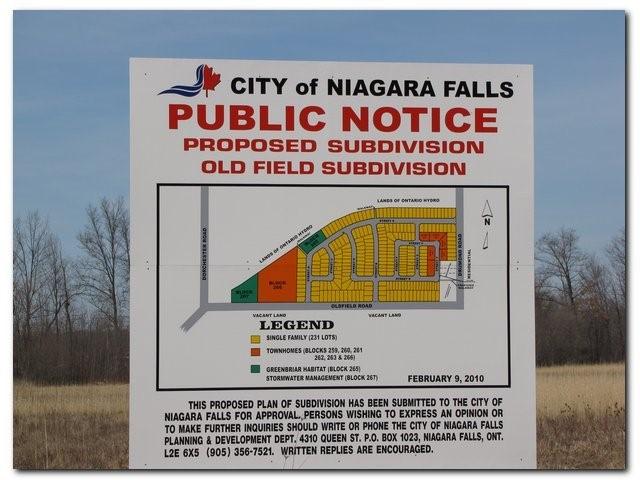
Another sign of our times in Niagara – more low-density development proposed for what is left of our green space. Photo courtesy of John Bacher
What is at stake is the application of the provincial Growth Plan to the Niagara Region. The Growth Plan was developed by the provincial government in order to compliment the protective policies against sprawl of the Greenbelt. The Greenbelt’s goal is to safeguard its “protected countryside” in perpetuity from sprawl, although its plan concedes that this may not be possible and will be periodically reviewed.
The Growth Plan compliments the Greenbelt by ensuring that there is not rampant sprawl up to the boundaries of its protected countryside. To do this it has a few basic concepts. One is that no new rural estate zonings or designations will be approved. Another is that land need for the purpose of urban boundary expansion is to be determined on a regional basis, rather than by individual municipalities. Another is that within urban boundaries there will be a built boundary to prevent premature development. This is to ensure that urban densities are built up sufficiently before any urban expansions take place.
Although it hasn’t been widely reported the Growth Plan has had a major impact in Niagara. The most significant was the successful provincial appeal to the Ontario Municipal Board of a proposed 600 acre area for unserviced estate lots in the former area of Willoughby Township in Niagara Falls.
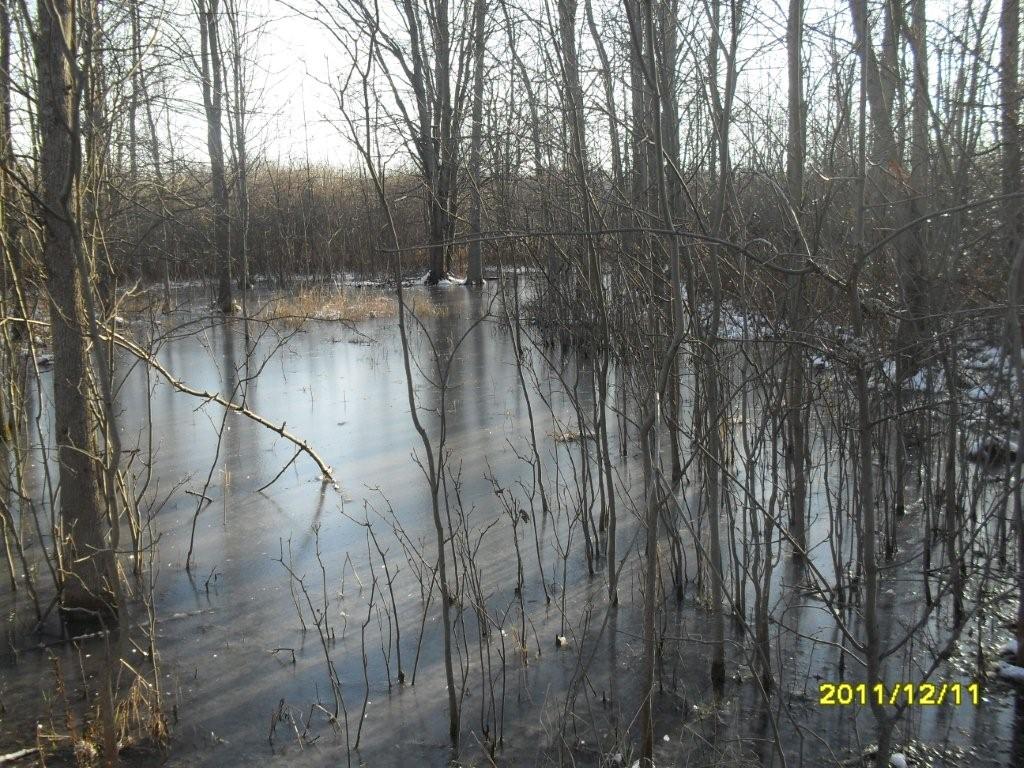
Wetland area on the proposed lands for the Old Field subdivision in Niagara, Ontario.
Enforcing the Growth Plan has been the reason also for the province holding firm against proposed urban boundary expansions in both Smithville and Niagara Falls. In Smithville the lands are of considerable significant to one of Ontario’s most threatened watersheds by climate change, the Twenty Mile Creek. Many of the lands proposed for expansion have sensitive Karst topography, a landscape full of underground caves and streams. This creek is already prone to drying up much of the year. In Niagara Falls the lands proposed for the urban expansion are the headwaters of Ten Mile Creek. There is a danger that this stream, now relatively pristine, might become contaminated with sewage as has the adjacent Shriners’s Creek. Both watersheds are also prime farmland, with the area in Niagara Falls having good potential for excellent grape land.
A report by the Niagara Regional Planning Department on April, 25 2012, called “Simcoe sub-area Amendment to Places to Grow and Possible Indications for Niagara,” gives a peep into some of the wheeling and dealing which is taking place over the proposed urban boundary expansions. Here the planners tell the councillors, who almost to a person defend these expansions, how, the new Simcoe County Amendment to the Growth Plan, ‘may have implications …especially the resolution of appeals” before the Ontario Municipal Board.
The Niagara regional planners gloat over various new loopholes they detect in the Simcoe County Amendment, which they hope will be used to justify paving over farmland in Smithville and Niagara Falls. They see “several key provisions built into the Amendment that provide flexibility for Simcoe County that are not currently enjoyed by Niagara Region…”
In their celebration of the Amendment to the Growth Plan, the Regional planners failed to let the politicians know how much tougher the province has been on Simcoe County than Niagara. The big difference there is that the province has actually enforced its built boundary even to the point of delaying development in approved plans of subdivision. The province has frozen development in such areas until the densities in the impacted municipalities have increased. Rather than being soft on Simcoe County, the province has also appealed efforts by Midhurst to expand its urban boundaries to the OMB.
In contrast to Simcoe County, no Niagara subdivisions have been held up that are outside of the built boundary. There is one subdivision proposal in Niagara Falls on Oldfield Road that is outside the built boundary, whose draft approval has been delayed by appeals to the OMB on a hearing to be heard in Niagara Falls on May 16. In the whole discussion of this proposed subdivision, which has resolved around a small forested portion of around ten acres which contains habitat for the threatened species the Round-leaved Greenbrier, going outside the built boundary has never been an issue for the province.
Land use planning issues are important. The biggest threat to biodiversity in Canada is urban sprawl onto the small Carolinian region of southern Ontario. Watersheds need to be draped in more forest cover, not concrete because of the reality of climate change. Unfortunately, media discussion reflect the in camera sessions of Niagara Region council where these issues have been debated in secret for the last three years.
John Bacher is a Niagara resident and long-time conservationist in the region. He has contributed a number of posts to Niagara At Large on land preservation and related issues.
(Niagara At Large invites our readers to share their views on this post. Remember that NAL only posts comments by individuals who also share their real first and last names.)
 Niagara At Large
The reality of Niagara Region development expansion is cheap development cost relative to say Halton where developers have to pay $32,000 per single family dwelling where as in Niagara from my last contact with region that cost was not yet at $10,000 per single family dwelling. Within the past three years the Region has attempted to bring parity into the scene and a motion had been put forth to increase the development costs. I have been led to understand, by an attendee at council, the developers circled the building in protest and a previous mayor (whose father-in-law is a developer) attempted to delay the implementation of the increase. Niagara is becoming a bedroom Region with little or NO industry and a work force in the “Service Side” drawing minimum wages to enhance the the lives of folks who move into Niagara after selling their higher priced homes in other districts such as Toronto.
LikeLike
It is a disgrace how we treat our water sheds ,we should revere them for their function if not their beauty! The Ontario Drainage act (130 years old ) turns our living watersheds and turns them into drainage ditches with all that destruction to the natural filtering qualities that living creeks provided. Any planning shold take into account FIRST the needs of our watersheds and to Enhance where ever possible their vegetative buffer to protect them from land use operations!!!
LikeLike