
By Doug Draper
In the Edwardian era of a century ago, he was classed as a “peasant” – one of those ‘lower’ members of the human species upper classes of people wanted little or nothing to do with.
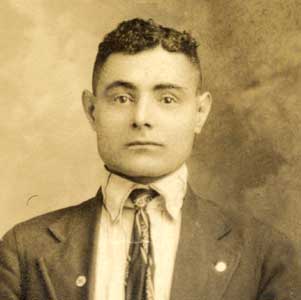
Titanic survivor Neshan Krekorian
So Neshan, who was in his early 20s at the time, and four of his Armenian compatriots made their way to Cherbourg, France where on April 10, 1912, having scraped together enough money to purchase third-class tickets, they boarded a ship bound for North America called the Titanic.
The Titanic, a White Star Line ship about to embark on its maiden voyage when Neshan and his friends boarded it, was billed at the time as the most luxurious liner to ever sail the seas and was also billed as “unsinkable.” It was, as someone according to legend said, “the ship that God himself couldn’t sink.” The opulence of the ship’s “Grand Staircase,” ballrooms and other first-class features were an illusion to Neshan when he and his fellow “peasants” boarded that boat. Its unsinkability would prove to be an illusion a mere five days later.

The Titanic at dock sidei in Britain before her ill-fated maiden voyage
That was the way it was for these third-class passengers until 11:40 on the night of April 14 when, according to Van, his grandfather heard “a dull, shuddering sound and the boat sort of felt like it was jerking to the side, throwing people off balance. … then, the lights flickered.”
It was the moment that The Titanic had its fateful collision with an iceberg and, although Neshan and didn’t know that at the time, he and some of the others had a feeling something was terribly wrong and they made their way to the chained gates that kept them in the steerage. They managed break through the chain, said Van, and shortly after 1 a.m. on April 15 Neshan was able to board a lifeboat with only 30 other people on it – less than half the number the boat could have carried. He helped row the boat away from the sinking Titanic and sometime after 4 a.m., he and the others were picked up by a ship called the Carpathia. The Titanic disappeared at 2:20 a.m. along with 1,503 men, women and children, including most of the crew and its captain.
Neshan was one of 713 people and one of only about 20 per cent of those who road third class who survived the disaster on a ship equipped with all of the finest trappings of the good life, but only enough lifeboats (20 in all) to save a fraction of those aboard.
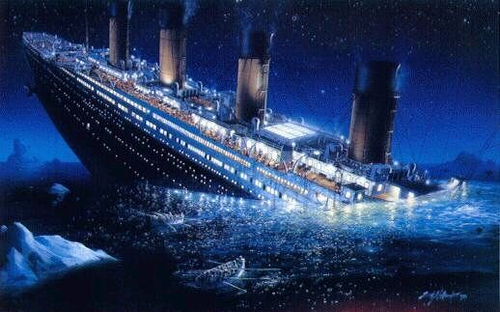
A film depiction of the Titanic's last moments.
The Carpathia dropped the Titanic survivors off in New York City where Neshan received enough money from White Star and the Red Cross to pay for his journey to Canada where he first joined a community of Armenian immigrants in Brantford, Ontario, where there was a small Armenian community, before settling in St. Catharines, Ontario. There he worked for a car parts manufacturer and raised his family before retiring and dying in 1978.
Van said that in the early 1950s his grandfather went to the St. Catharines premier of a movie about the sinking of the Titanic called ‘A Night To Remember’, but he was reluctant to say very much to his family about the disaster. “Clearly, it was a very emotional and stressful subject for him,” Van said.
Yet it has remained a subject of public interest now for 100 years. “I don’t completely understand all the fascination” over the Titanic tragedy, said Van. “What I do know is that if my grandfather hadn’t survived, I would not be here. … and I can’t help but wonder why he was blessed and so many others were not.”
This coming Sunday, April 15, CBC television will be rebroadcasting a documentary on its Doc Zone series called ‘Titanic – The Canadian Story’ about individuals with links to the tragedy and the ship disaster. Neshan Krekorian’s story will be among those featured in the two-hour documentary that will air in the evening on on Cable 26 on Cogeco. Check your listings for the time of the rebroadcast.
For more information on the documentary click on http://www.cbc.ca/doczone/titanic/2012/03/neshan-krekorian.html .
The documentary also features a story about another Titanic survivor by the name of Madeleine Mellenger, who eventually settled in Niagara, Ontario and is buried with her husband in the St. John’s Anglican Cemetery in the Fort Erie community of Ridgeway. NAL would be pleased to post any brief write-up, along with any photo that could be shared, on her.
Finally, there was a man who lived in the old Glenridge area of St. Catharines, Ontario who was a wireless operator on the east coast of Canadian during the Titanic sinking and received some of the last distress signals from the ship. If there are any relatives or other acquaintances of those individuals, Niagara At Large would like to hear from them by email. Please contact drapers@vaxxine.com .
(Niagara At Large invites our readers to share their views on this post in the comment boxes below. Please remember that we only post comments by individuals who are also willing to share their first and last names.)
 Niagara At Large
There are other connections to our area regarding the Titanic disaster. Albert Ervine, whose nephew lived in Ridgeway and who I knew since childhood (Clement Ervine passed away four years ago) was only 18 when he died aboard the Titanic. He volunteered to stay below decks, no doubt knowing he would die, in order to keep the electricity going both for boarding the lifeboats and for the wireless to call for help. He was an electrician who worked on the ship and asked to be on the crew, being transferred from another ship. He wrote a letter and sent a photo to his mother from Queenstown (now Cobh, Ireland) the last stop for the Titanic, saying the ship couldn’t sink because they installed electric doors that would prevent the ship from sinking. Unfortunately, they did not go all the way up to the top deck and had Murdoch, the First Officer on duty that night, struck the iceberg head on rather than try to port around it, the ship would have survived but it was side swiped and riped open too many compartments. Albert Ervine, the youngest below deck crew member to die was a hero. He was featured in the “Saving the Titanic” documentary on PBS which will be rebroadcast next Tuesday.
LikeLike
Elizabeth Mellinger, who lived in Ridgeway, and her daughter Madeleine who was 13 at the time of the sinking, were emigrating to the US to be an au pair for the wealthy Colgate family after being deserted by her husband. After the disaster they returned to England but emigrated to Canada in 1915. I had the pleasure of meeting them but, being very young, did not recognize the privilege that was. They were in 2nd class and saved in lifeboat 14 on the starboard side but transferred to number 12 by Officer Lowe, the only one who returned for survivors. Elizabeth died in 1962. Supposedly due to the shock, she became deaf. Madeleine married David Mann from Welland and they had four sons. She died in 1976 and both are buried in St. John’s cemetery on Ridgemount Rd in Ridgeway. Both attended a reunion of survivors from the same lifeboat in1939 in Toronto at the Royal York.
There is going to be a memorial service with music of the era and some displays in St. Catharines on Saturday at the music school on Court St if anyone is interested.
LikeLike
Thanks for posting this Doug. I think I went to school with one of Neshan’s great grand-daughters. I’m looking forward to the documentary…
LikeLike
My grandfathers granddaughters (me included) are all mid40’s to mid 50’s now. His 2 great grand daughters are 21 and 8. There is so much more to this story to tell in terms of the Niagara connection.
Respectfully, Sheila Krekorian
– A note to Sheila from Niagara At Large … NAL will do its best to tell it in the days ahead as we approach the anniversary of possibly the most infamous disaster story of all time. Doug Draper
LikeLike
The story has been well told by Van Solomonian-with regards to my Grandfather-there was limited time and space so its not about the Grandchildren or Great Grandchidren its about The Titanic and what our Grandfather went through and how proud he was about his childrens accomplishments –
LikeLike
Respectfully Paula, Sheila’s reply about Neshan’s grandchildren was directed to Mr. Wilson’s inquiry that he perhaps attended school with the granddaughter of Neshan Krekorian. Seeing as Sheila is his granddaughter, who better than Sheila to address that question, unless of course, you’d prefer Van to comment on that too? While the story has been “well told by Van Solomonian”, I was never made aware that only one family member had the right to comment about our ancestor’s place in history. You are correct that the story is about our grandfather’s experience on the Titanic and his pride in his children’s accomplishments……accomplishments that no doubt included having grandchildren. I know my grandfather would be proud of the article posted by Mr. Draper, as were Sheila and I. We look forward to any further entries by Mr. Draper regarding the Titanic and its Niagara connection.
LikeLike
To Linda McKellar;s comment: Albert Ervine was my mother’s older brother, known to the family as “Bertie” and named after his father, a well-known lay preacher in the North of Ireland.
There is a monument to the crew of the Titanic in the grounds of the City Hall of Belfast from which city many of them originated
LikeLike