
By Doug Draper
The trust and satisfaction members of public feel for the Niagara Health System – the body responsible for managing a majority of the hospital services in Niagara, Ontario – is extremely low, says Terry Flynn, a McMaster University researcher who has a long background in doing public surveys on organizations.
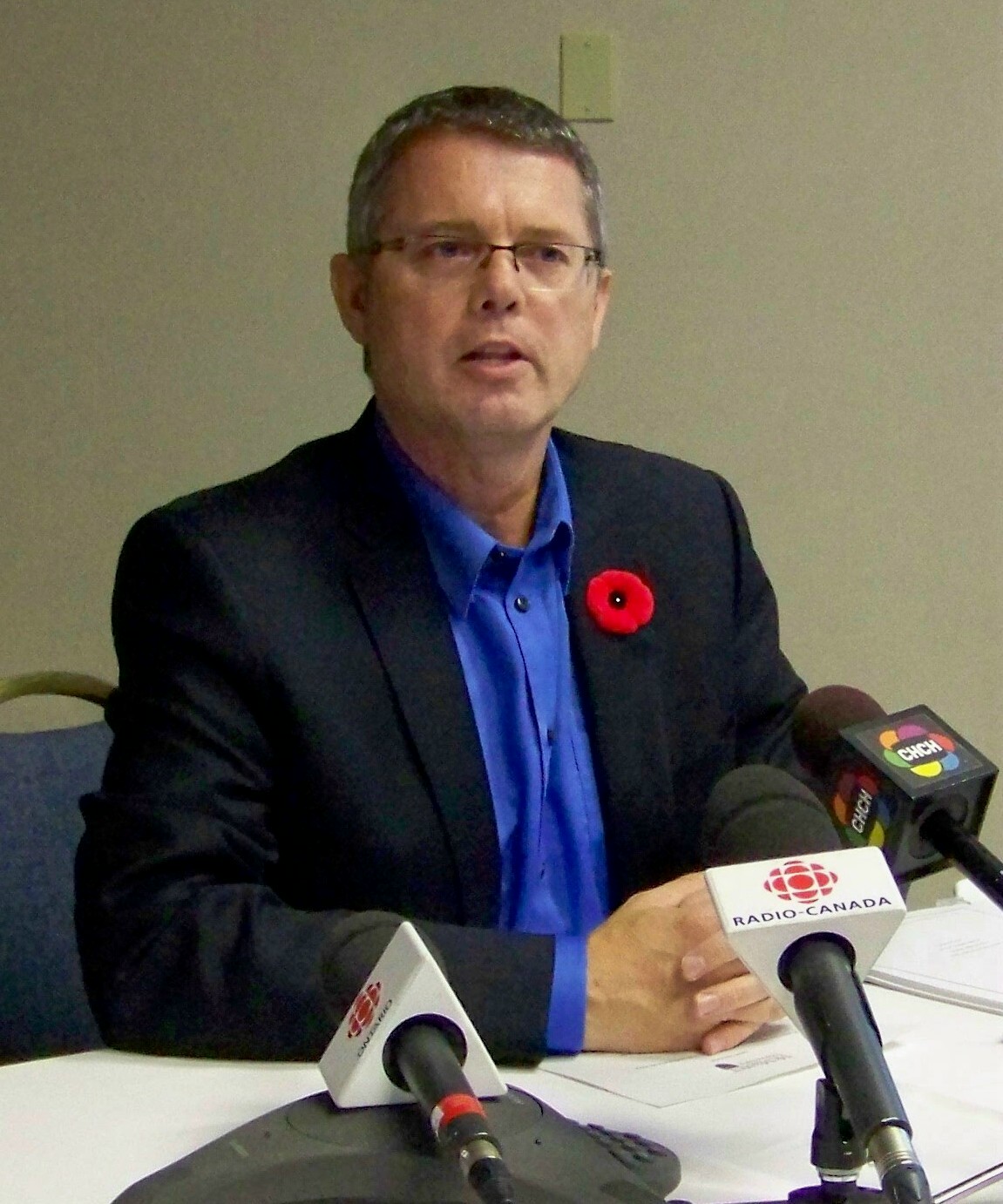
Terry Flynn outlines survey results. Photo by Doug Draper
In all of his more than 30 years in the field, Flynn told a media conference in Niagara, Ontario this November 9 that in all of his more than 30 years in conducting public opinion studies on organizations, “I have never seen reputation scores this low. Even Toyota, in the heat of their controversy (a few years ago over faulty gas and break peddles), did not have a reputation score this low.”
“The message is that the reputation of the NHS is damaged and the relationship they have (with the public) is fractured,” added Flynn following exhaustive surveys he and his team conducted this summer and fall through phone interviews, questionnaires and more in-depth one-on-one interviews with more than 4,000 Niagara residents, including NHS employees.
The results of the survey, called for last July by a beleaguered NHS board that was finally coming to the conclusion it was facing a growing crisis of public trust in its operations, should not come as much of a surprise based on so many concerns residents have raised about the organization in recent years, said Flynn.
“This is a damaged reputation and it is significantly damaged,” he added during a detailed presentation of statistics showing most scores for the NHS when it comes to trust and satisfaction are way down in the negative range.
“The NHS has a long road ahead if it is to succeed in regaining the public’s trust and recovering its reputation,” concluded Flynn and fellow researchers Rebecca Edgar, Douglas Calderwood-Smith and Sheila Hartford, in their report on the survey results. “It will not happen overnight and it will be based on meaningful action and tangible results over an extended period of time. Communications efforts, no matter how well intentioned, planned or executed, will not provide the solution alone. And while our sincerest intention is to assist in improving communications between the NHS and community, we recognized that actions speak louder than words.”
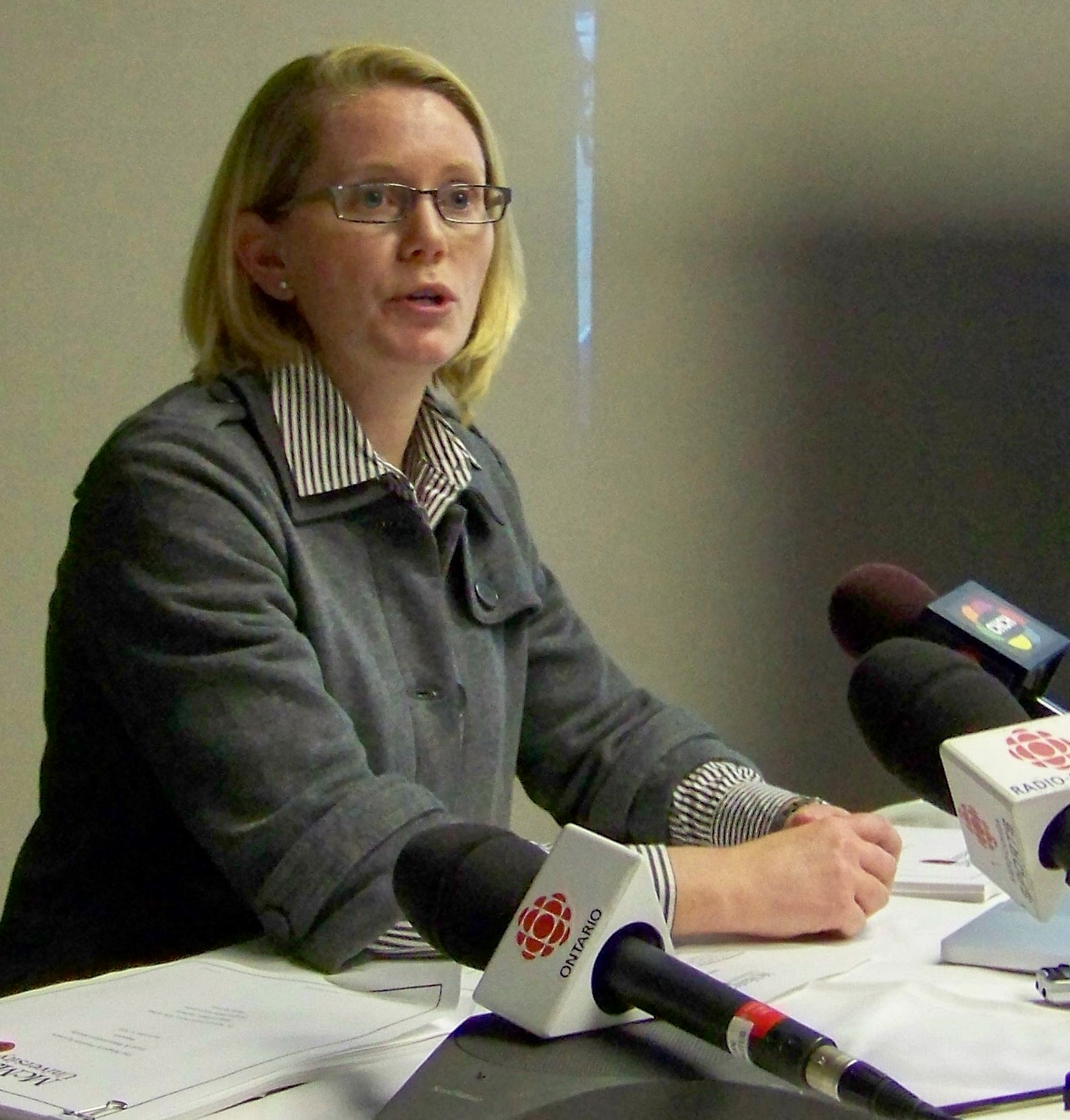
Survey researcher Rebecca Edgar stresses need for more public involvement in NHS operations.
At the media briefing, Flynn and Edgar said all is not lost for the NHS, however, and there are still opportunities for regaining some or all of that lost public trust. The survey shows, said Flynn, that many Niagara residents still do have respect for front-line employees, including doctors and nurses, at NHS’s hospital sites. “My hope,” he added, “is that the employees who read this survey would see that there is a light at the end of the tunnel.”
Another ray of hope, according to the survey report, is “that the residents of Niagara Region care deeply about its health care system. They want it to improve and they want to be involved in the solutions. There engagement – community participation – will play a big part in future results.
Edgar said she, Flynn and their co-researchers on the study are recommending to the NHS that it establish and community advisory committee to assist it in its decision-making. They are also recommending that as well as taking more seriously the feelings and concerns of patients and their families, the NHS find some means of letting the public have some say in who sits on its board.
Rather than shutting out its critics, said Edgar, the NHS should consider the possibility that some of its toughest critics could become part of solving problems in the hospital system if they are given a real opportunity to engage in the process
The research team added that some of the results show that relations with the public have begun to show some signs of improvement since the provincial government brought in Kevin Smith, a president and CEO of the St. Josephs Health System, to assume the role of supervisor of the NHS in September.
In a written statement this November 9, the NHS said that while the organization has not yet reviewed the survey report in detail, “we are extremely pleased to have such a comprehensive assessment. We hope this report will be seen as another positive step toward rebuilding trust.”
“Our leadership will be taking this report extremely seriously, and will work closely with Dr. Flynn to develop an action plan to address his findings and recommendations.”
Sue Salzer, a Fort Erie resident who heads up the Yellow Shirt Brigade, a citizens group fighting for fair access to quality hospital services across the region, said yesterday that while all of this, including the recommendations for more public involvement in NHS affairs sounds good, “it remains to be seen whether it translate into front-line action.” We be watching,” she said.
Niagara At Large will have more to say about this survey in the days ahead. Meanwhile you can review the full survey report which has been posted on the NHS website at http://www.niagarahealth.on.ca/ . And, of course, we invite you to share your views on this post below. Please remember that we only post comments with real names attached to them.
 Niagara At Large
Action NOW – not words — at this point words are meaningless – reviews only serve to delay ACTION
LikeLike
Is this result a surprise to anyone?
First, they say communications alone cannot solve the problems. Very true. NHS communications have always been basically PR propaganda. This propaganda would not even be necessary if their commitment to the public and improved services were front and center. A little more action and a lot less talk.
The idea of using NHS critics to assist in correcting the deficiencies of the NHS is essential. Critics don’t just jabber on for the good of their health and to hear themselves talk. There has always been much positive input but it has been constantly ignored and even demeaned by the NHS administration or dismissed with worthless platitudes. The critics are actually trying to help for heaven sake and if there was no need for criticism they wouldn’t be there in the first place.
Again, when the NHS has a problem, rather than handling it themselves they perpetually hire consultants be it this survey or Dr. Smith. What are the overpriced adminisrators paid to do
LikeLike
Cont…. Please excuse my wierd computer for cutting off…. Christmas is coming if anyone wants to buy me a new one….
I find it has been practice FOREVER for the NHS to hire consultants, pay them big bucks and, more often than not, ignore the recommendations anyway. Let those who are in administration solve the problems and, if they are not capable of doing so, fire them, no severance.
When most people are fired they don’t get paid off!
Administration must also listen to their own staff. THEY know what is necessary because they deal with the problems every day.
LikeLike
Just when you think you have heard it all. A local paper reports the following quote from Mr Smith following the release of the scathing Flynn report.
“The basis of great health care delivery is good communications”
Whatever happened to good patient care, cleanliness, adequate beds,emergency care,shorter wait times and all the elements for patient satisfaction as a good basis for a Hospitals operation.
Most patients really won’t give a hoot to hear that the NHS is known to have a great communication system with all the other glaring deficiencies created by the HIP.
LikeLike
There are also broader issues at play here. Bank Of Canada Governor Mark Carney has said “…(we) need to find ways to allow big banks to fail if they get themselves in trouble, instead of showering them with tax-payer funded bailouts…” Additionally, it should be noted that “shadow banking”, derivatives, hedge funds etc. were key players in the 2008 market crash. More regulation and a financial transaction tax would help cure that. These and other examples of unregulated neoliberalism/neoconservatism mean that tax dollars are being siphoned off to areas other than hospitals. There’s plenty of money out there if it’s used wisely, but If current economic and political systems don’t change, healthcare will likely continue to suffer. And more privatization of healthcare equals more societal ills.
LikeLike
You are correct in my opinion Mark. Most of the social ills from which we currently suffer are from unbridled Capitalism. Capitalism is fine but must not be allowed to be the sole controller and motivating factor in society. When money is too heavily invested in hedge funds and hoarded away in Grand Cayman and Switzerland, it is not being recirulated. This means social programmes suffer. Also, when these big business and banks take money out of circulation by hoarding or by outsourcing elsewhere, jobs disappear. If the average Joe is jobless, he is not paying taxes but collecting social benefits so his/her contributions to public institutions like hospitals is diminished. The money really is not out there but hidden away from the public good. I hope this is not too off topic but hoarded money benefits nobody but the hoarder. Further to this,if hospitals are privatized for profit, health care costs will increase astronomically and care will be available
LikeLike
The next thing we know Taliano will determine that the tides that cause sand to erode are not controlled by the moon but by a bunch of neo-somethings on Bay Street. But it is good to see that his tent has internet and a computer that he purchased from corporations that he says are ruining the global economy.
LikeLike
Only to the wealthy and sub quality care will be left for everyone else. That would further feed unbridled Capitalism and exacerbate the problem even more. The cycle will become endless.
LikeLike
Nick, according to experts in Finance there is 40 times more money tied up in hedge funds than the total of all stocks and bonds in the world. And NOT if but WHEN the bumble bursts, Mark Taliano’s words will fulfill the prophesy of those learned people. The Greatest Depression this world has ever known.
LikeLike
Very accurate Joseph. As well, CEO’s earned 40x the salary of their employees, on average, in the 80’s. Now they earn 300x. Is that fair? Furthermore, as stated, that money is NOT going into social programs or being reinvested in the economy for the general good…it is being hidden away and not spent. How many mansions, yachts and fur lined sinks can one CEO’s family have at the expense of the general good such as improved Univeral health care?
LikeLike
Mr. Strugar’s logic is defective. In a sense he is saying, because lowly plebeians have computers, all actions, competent or incompetent, by big money organizations are OK. Let me give a down to earth clarification that relates directly to Doug Draper’s published article. Months before NHS closed the ER’s in outlying towns (like Fort Erie), I used my computer and internet connection to warn the NHS CEO that such action would lead to (the business-created artifact of) ‘time-critical’ emergencies being shunted out on the highways – and dying – instead of being put at the head of the line in the outlying hospital – and perhaps living. Did my forewarning NHS of possible deaths (like that of young Reilly Anzovino), using my computer and internet connection to do so, justify NHS’s negligence in refusing to acknowledge let alone act upon the warning and others like it? Weird logic, eh.
LikeLike
Dr Hogg, you are guilty of the logical fallacy known as straw man. Mr Strugar did not say anything of the sort, and I suspect you’re smart enough to know that.
Linda, I’d like to see an example of unbridled capitalism outside of a text book. None exist.
IMO (and Ashley Brilliant’s) losers apportion blame. Winners find the problem and fix it.
Nevertheless everybody here seems interested in blame, and nobody here has fixed blame correctly. There are two things to blame:
1. Keynesian economics. The idea that a fiat currency can be inflated in perpetuity is clearly insane… to those of us who are sane.
2. Fractional reserve banking, coupled with private banking cartels (such as the Federal Reserve and Bank of Canada) , that only look out after their members.
If you’re curious, look up Austrian School economics, Ludvig von Mises and Murray Rotbard. For many years Austrian economists have been predicting exactly what’s happening now. It’s the Keynesians and their whack job policies, helped by politicians, who’ve seen to it that a handful of wealthy bankers ended up with most of the taxpayers’ money.
LikeLike
Thank you, Mr. Chappelle. You are entirely correct – on all counts. Bill H.
LikeLike
This is a very relevant article for anyone interested in measuring satisfaction survey and customer loyalty. Especially the automation part I find quite interesting and relevant.
Satisfaction Survey
LikeLike