
By Fiona McMurran
After parking the car in downtown Toronto on Saturday morning, Timothy Healey and I walked along Adelaide Street, looking for the Occupy Toronto gathering. Everyone else on the street – individuals and little groups of two or three – seemed to be heading in the same direction. Most weren’t identifiable as “activists”. They were just ordinary people of all shapes and sizes – old, young, students, a few folks in suits, parents with small kids in tow – looking to get involved.
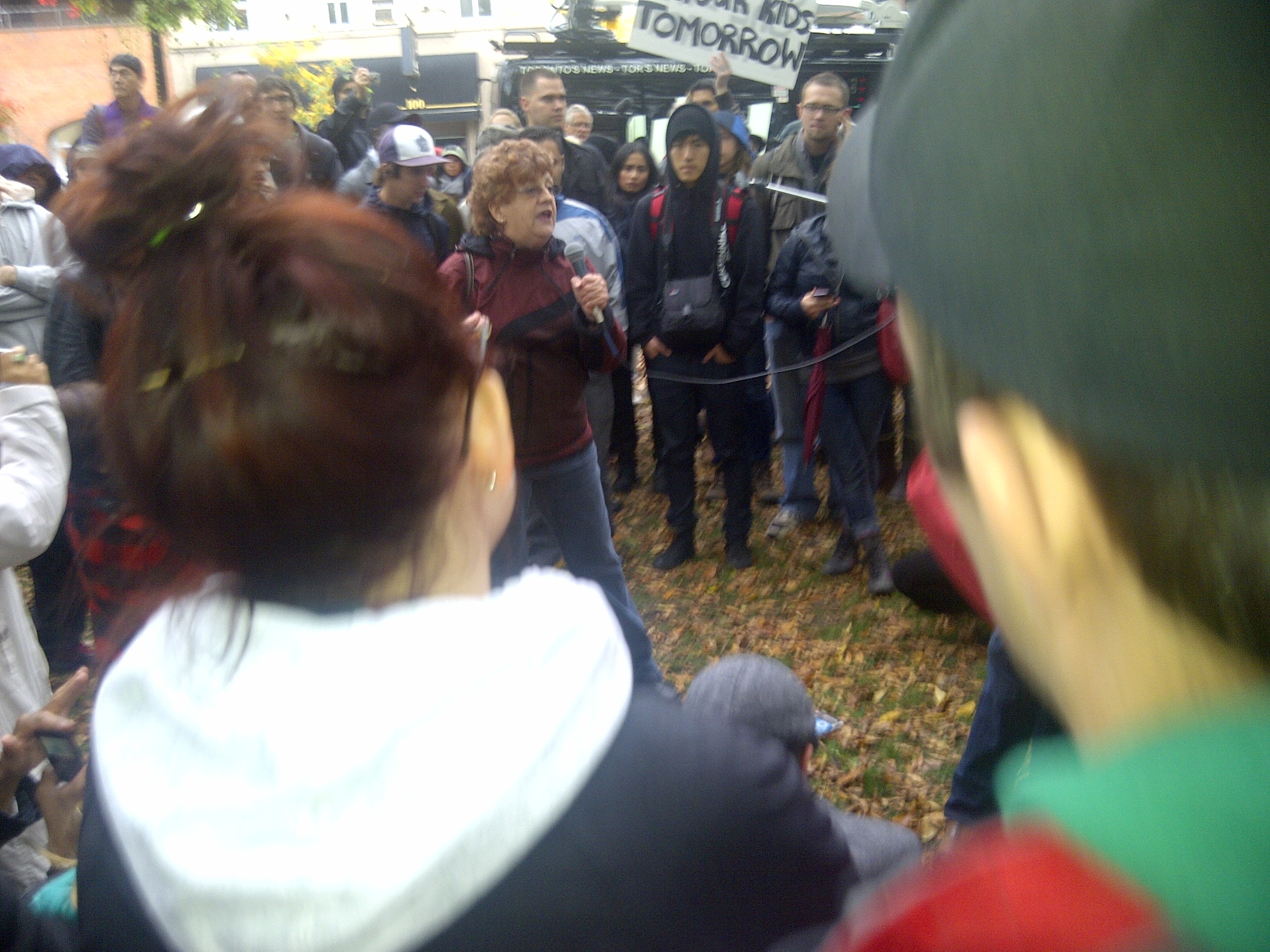
Niagara's Fiona McMurran telling it like it is at the 'Occupy Toronto' railly. Photo by Saleh Waziruddin.
We found the group — a surprisingly large one — at the corner of Bay and King, in the heart of the banking district. It was 10:30 a.m., and people were arriving all the time, just like us.
Nobody seemed to know what was going on, but that didn’t appear to matter. The atmosphere was expectant, but also relaxed, even jovial. Despite the size of the crowd, it was surprisingly easy to move around, looking for – and connecting with — people we knew. There was no pushing or jostling; people just moved aside, as if the crowd were some kind of liquid, fluid and adaptable.
There didn’t appear to be any specific leader, or obvious agenda. Instead, various facilitators, who had been part of the earlier General Assemblies planning this Oct. 15 Occupy Toronto rally and the on-going occupation, took turns explaining how the day was going to proceed. When they had something to communicate, these facilitators would call out “mike check”; those words were echoed by people surrounding the speaker. The call would then be echoed to those further out, and so on until it reached those on the fringes. Everyone quieted down to hear the following messages, which were relayed in short phrases using this group communication process called the “people’s mike”. The technique is borrowed from Occupy Wall Street. To use electronic amplification on the streets of New York City, you need a permit, so the “people’s mike” became an alternative means of passing messages.
At first, it seemed a slow and silly way of communicating, like indicating agreement or disagreement by means of simple hand signals, rather than yelling or clapping. Like everything else in this movement, however, this method of communication is a different way of doing things, and it has its virtues. A speaker has to use short phrases, so messages have to be both clear and concise. As his/her words are being passed along from group to group, a speaker can consider carefully what he/she is going to say next. And the group has time to think about what’s being conveyed. This method makes it almost impossible to whip a crowd up into a mob frenzy through powerful rhetoric. (This all sounds much more staid than it was. People were laughing or kibitzing in the space between statements – but not so as to interfere with the process.)
After absorbing a few ground rules intended to keep things peaceful and respectful, we started to walk along Adelaide, to our destination (only just now revealed to us): St. James Park, on the corner of Jarvis Street. As we walked, the difference between this and last summer’s G20 march struck me. That was an “us and them” affair; we marched under banners identifying us as part of this or that group, past curious on-lookers, down streets lined with hundreds of security personnel in riot gear, staring at us through lowered visors.
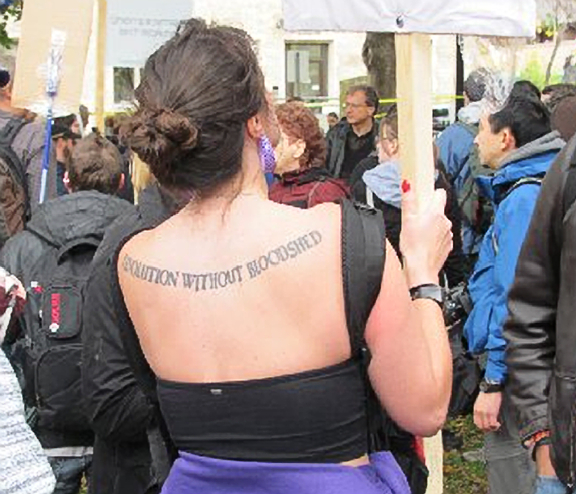
Photo by Saleh Waziruddin
Today, we were all individuals, participating for our own reasons, but nevertheless united in our desire for positive change. Union and citizen action group leaders, although participating, seem to have agreed that this movement should be allowed to find its own voice. So there were comparatively few banners, but lots of signs. Almost all bore hand-lettered messages of all kinds, many using humour to admonish (governments and Big Finance: the 1%), encourage (us: the 99%), and warn.
Another big difference from the G20 was the lack of boundaries. Torontonians came to watch and found themselves joining in, making the movement inclusive, rather than divisive. Toronto police were out in force, but on bicycles and in their cheerful yellow-accented uniforms, keeping their distance, respectful and unthreatening, chatting with us from time to time. What a contrast with the menacing and heavy-handed G20 security forces. (Was Toronto Police Chief Bill Blair making a point? I wondered. Would the outcome of the G20 have been different if security measures had been under municipal control?)
Once in the park, groups coalesced in different areas, and different activities began. Some were celebratory, such a drumming and other kinds of performance. People joined in, left for a time to warm up with a coffee and use a washroom, and returned. It was all casual, but far from chaotic.
In one corner, a hand-held mike (an actual one, this time) allowed individual speakers to come forward and share their thoughts. Most speeches were positive messages, some delivered as dub poetry, or punctuated by song (one from a Raging Granny). Many who came forward were Canadians from other countries, who shared their feelings about their love of Canada and their concern for where the country is going. A young Egyptian Canadian talked of the Arab Spring and how it inspired her.
When my turn came, the friendly crowd encouraged me, and I lost my nervousness. I told them about Niagara’s hospital problems and the deaths from c. diff. I told them that it had taken the community nearly three years to be heard by the Ontario government. I urged them to take ownership of their healthcare systems, to get informed, to work together to identify the most important needs in their communities and to speak out, because much deeper cuts to services are coming.
Bob Rae, MP for the riding that includes St. James Park, came to the edge of the park, and was soon surrounded by media, eager to get the opinion of an important politician. I wondered what Rae was saying. Yes, he’s part of the 99%, like us, but how much are our elected representatives enabling the 1% to stay in control? Some, perhaps most, politicians go into public life to speak for the people. Those who end up being enablers of the 1% may honestly believe that helping the rich get richer will result in a better life for everybody else. But the “trickle-down” effect is a delusion, and more and more of us realize that. The future may require a totally different kind of politics; in the meantime, our elected “enablers” must be taken to task, because theirs is a betrayal of the trust we have put in them to represent our interests.
The first item of business was to move to consensus on the way of working. It’s a slow and sometimes frustrating process. There are no leaders; the idea is that everybody is a leader, and there is therefore no concentration of power vested in any single person or group. This is a way of working together that is foreign to most of us, although not to all. Many of the younger people have experience in this kind of consensus-building process. They seem to have wisdom, respect, infinite patience; their manner of engaging with this process is itself part of the process. It inspires us to try to emulate them: to listen, to think, rather than to react.
We stayed, participating in discussions of process, until the General Assembly broke up at about 7:30 p.m. During the afternoon, volunteers had been unobtrusively setting up a food tent, a medical centre, a row of PortaPotties, and water stations. Those intending to occupy the park had put up their own tents and were preparing to settle in.
We left knowing that we would return. Why? Because this is much more than a protest movement. This isn’t about whining at governments to look after us better. This is about ordinary people getting to the roots of the problems that plague us, and finding consensus on ways to move toward solutions that can sustain both human society and the world we live in. It’s about taking ownership of the issues that concern us.
Occupy Wall Street started as a protest and has evolved into a process, and that process is being copied in other cities around the world, such as Toronto. That process is about genuine, grassroots democracy. It’s creating a space and a way of proceeding to allow everyone his/her voice on issues related to the injustice of the growing gap between the 1% and the 99%.
This process, clumsy and unfocussed as it may seem, is a medium for substantive change. What message is the Occupy movement trying to convey? I can only quote Marshal McLuhan: “The medium is the message.”
Fiona McMurran is a Niagara resident and an area representative of the nationwide citizens group, the Council of Canadians. She is also a frequent contributor to this site.
(Niagara At Large invites you to share your views below. Remember that this site calls for accountability. That means that we only post comments from people willing to share their real first and last names.)
 Niagara At Large